How to license your company's data to AI companies
How to license data to AI companies: the five-step order (NDA, sample, rights check, licence, delivery), what qualifies, what buyers ask for and what happens at term end.
You license company data to an AI company by granting a scoped, time-limited right to use it for a named purpose, such as training or evaluation, while you keep ownership. The safe order is paperwork first, then a small sample, then a written rights check, then the licence, and only then delivery and payment. Nothing confidential should move before a mutual NDA is signed.
What does licensing your data to an AI company actually mean?
A data licence is a contract that lets an AI team use a defined set of your records, for defined purposes, for a defined time. Ownership never changes hands. The licence sets what the data may be used for, whether anyone else can license it, how it is delivered and stored, and what happens when the term ends. It is not a sale.
The distinction matters because the two words get mixed up in press coverage and in sales pitches. When Google won the auction for Spirit Airlines’ internal records in 2026, Business Insider reported it as a purchase from a bankruptcy estate, which is what it was. Most operating companies are not in that position. They want to keep their records, keep control over who uses them, and earn from them more than once if the data is non-exclusive. That is a licence.
| A licence | A sale | |
|---|---|---|
| Title to the data | Stays with you | Transfers to the buyer |
| Permitted use | Named in the contract, nothing outside it | Whatever the new owner decides |
| Term | Defined, with an end date | Permanent |
| Other buyers | Allowed unless you grant exclusivity | None, the data is gone |
| End of term | Copies deleted, deletion certified | Nothing comes back |
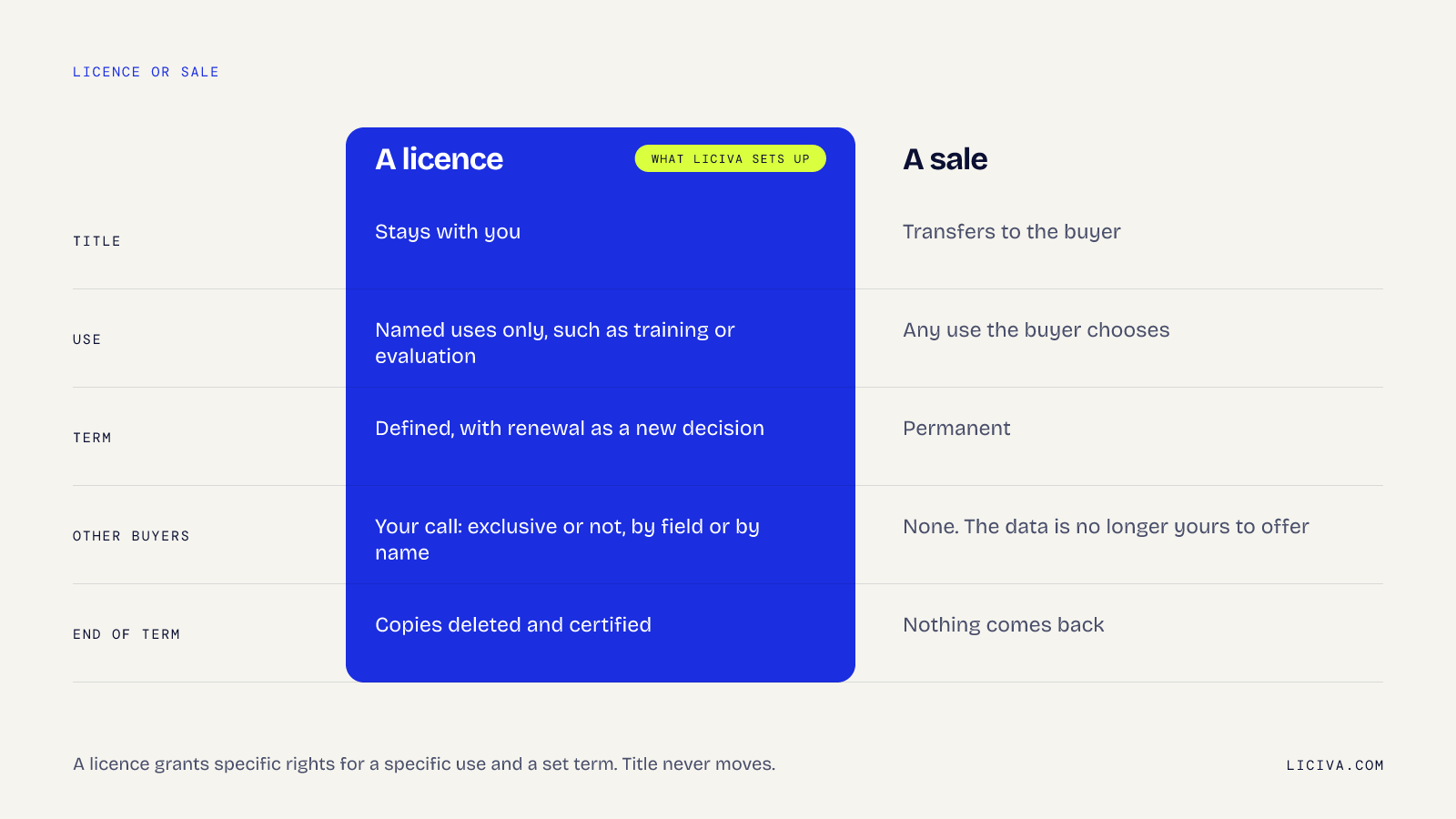
Every deal Liciva arranges is a licence with this shape. Title never leaves your company, the use is scoped, the term is set and deletion is written in. The four commitments on the homepage say the same thing in fewer words.
What kind of company data do AI teams license?
AI teams license records of real work: the data that shows how a job is actually done, step by step, over time. Support conversations, tickets, code with its commit history, engineering drawings with their revisions, de-identified clinical records, machine logs. This kind of material does not exist on the open web.
The Spirit Airlines sale shows the shape of what buyers are after. According to a court filing described by Wired, the estate’s data included more than a million time-card records, 80,000 email accounts, tens of millions of SharePoint and OneDrive items and 500 million Teams records. Decades of records that show how real work gets done are what buyers are paying for.
Five things decide whether a dataset is worth licensing, and the same five decide its price:
- Uniqueness. Can a model learn this anywhere else? Private, specialist, long-horizon records score highest.
- Volume. Enough to teach a pattern, with years of history where possible.
- Rights cleanliness. Whether you can actually grant the rights. This is the item most owners underestimate, and the one a buyer’s lawyers will test hardest.
- Exclusivity. An exclusive licence is worth more to one buyer but closes the door to every other buyer for the term.
- Use. Pre-training, fine-tuning, evaluation and safety testing carry different value and different risk.
The catalogue on the homepage lists the fields Liciva works in, from business records and code to healthcare, engineering, robotics, science, audio and geospatial data, and names what is checked first in each. It describes the kinds of data accepted; it is not a claim about any client.
How does a data licensing deal work, step by step?
A sound deal runs in a fixed order: mutual NDA, scrubbed sample, written rights check, scoped licence, then delivery and payout. Paperwork comes before data, and checks come before money. If a counterparty asks for a file listing or a sample before an NDA is signed, that order has already been broken.
This is the five-step process Liciva runs on every deal.
- Mutual NDA. A short call about the kind of data you hold, with no specifics. Then both sides sign a mutual non-disclosure agreement. It covers the fact that you are talking at all, so your name is never attached to a dataset without your consent. You get a signed NDA in your own legal team’s hands.
- Sample. A small, representative sample, scrubbed of personal data, shared under the NDA so its value can be judged. You get a plain-English read on demand and fit before you spend time preparing anything larger.
- Rights check. A written review of whether the data is yours to license: chain of title, third-party terms, consent and personal data, restrictions, use limits, and delivery and deletion. You get a rights memo you can keep on file. The rights check post goes through each area.
- Licence. A scoped licence that sets the use, term, exclusivity, territory and deletion terms. You approve every permitted use and can exclude named competitors or whole categories of use. Both legal teams sign.
- Delivery and payout. Encrypted, logged delivery into an approved environment. You are paid on the agreed schedule, and you receive a delivery record. At term end, a deletion certificate.
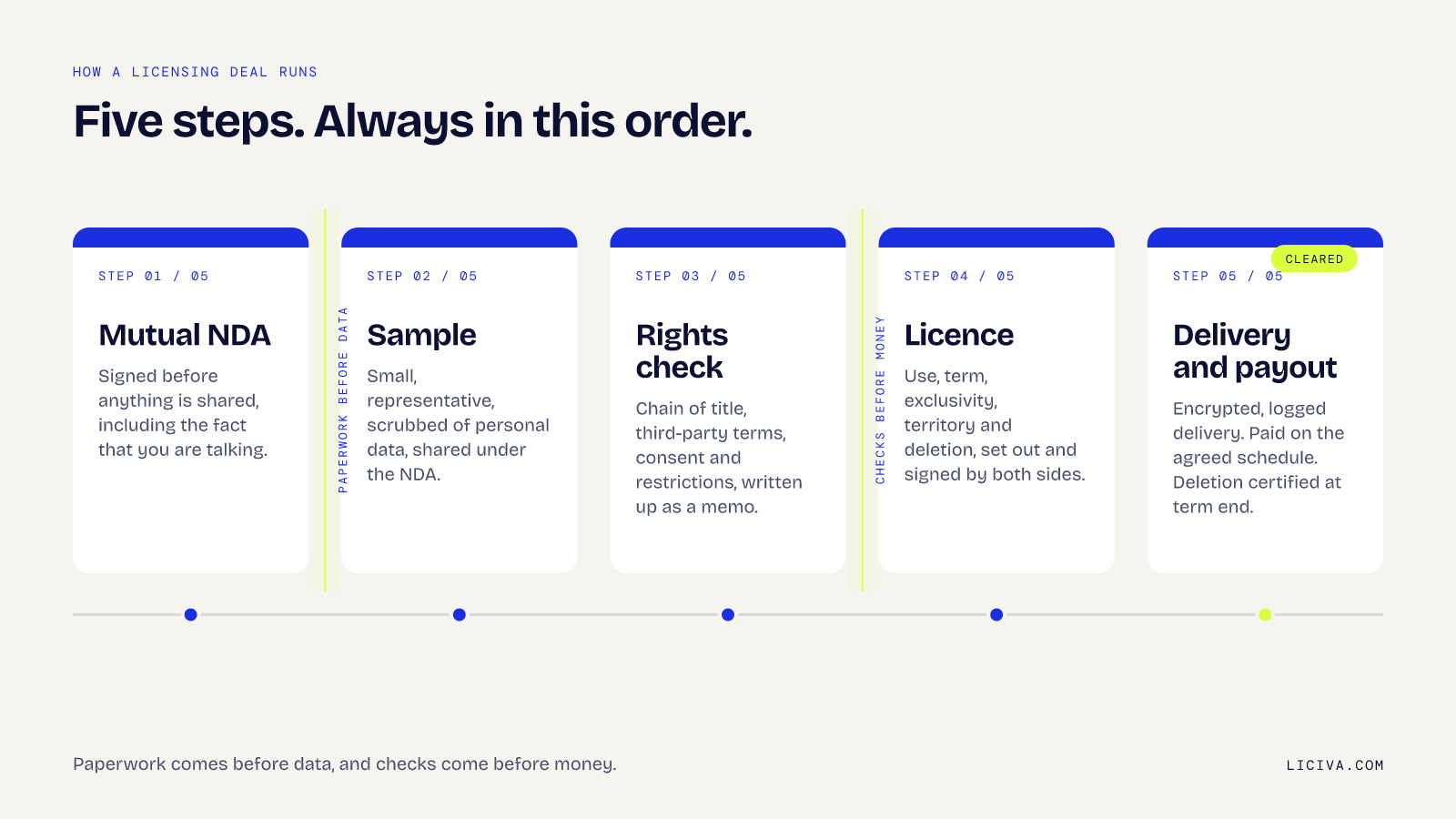
The two gates in the diagram are the whole point. Nothing is shared before the NDA, and no licence is drafted before the rights memo exists. The call, the NDA, the sample review and the rights check cost you nothing. Liciva earns nothing until a licence is signed and paid for, on terms agreed with you in advance.
What should you check before you talk to anyone?
Before any conversation, make an honest inventory: what you hold, how far back it goes, whose information is in it, what you promised customers and staff when it was collected, and which contracts limit what you can do with it. You do not need a data room for this. A page of notes is enough for a first call.
Use this checklist. Each item maps to something the rights check will look at later, so answering it now saves weeks.
- What you hold. Systems, formats, rough counts. Email, chat, tickets, CRM, repositories, drawings, recordings, logs.
- How far back it goes. Years of history are more valuable, but older records were collected under older promises.
- Whose information is in it. Customers, staff, suppliers, patients, bystanders in footage. Personal data is not a blocker, but it has to be handled, and some of it cannot be cleared. The employee data post covers the hardest case.
- What you promised. Privacy notices, employee handbooks, customer terms, consent forms. A licence cannot go beyond what the people in the data were told.
- Which contracts restrict it. Customer confidentiality clauses, vendor terms, open-source licences in code, grant conditions in research data, client ownership of designs.
- Who created it. Staff, contractors, partners, users. Chain of title starts here.
- What you would never allow. A competitor, a sector, a use. Decide this before someone asks.
The last two items on a buyer’s side are not academic. Business Insider’s October 2026 report on the market for workplace data describes a group that approached data vendors with a codebase it turned out not to own, and quotes Emory law professor Ifeoma Ajunwa asking whether employee consent to collection “actually extend[s] to the sale of the data.” Those are rights questions, and they are answered before a licence, not after.
What will a buyer actually ask for?
A serious AI buyer asks for four things: a representative sample, a clear statement of what the data is and how it was collected, evidence that you have the right to license it, and a licence that fits their legal exposure. The third item is where most deals slow down, which is why the rights check comes before the licence.
Buyers have become careful for a reason. In the Bartz class action, NPR reported that the court treated training on books as fair use while the company still agreed to a $1.5 billion settlement over how copies were obtained, with authors entitled to roughly $3,100 per title. How data was acquired turned out to matter as much as what was done with it. Any buyer who followed that case now asks every supplier to show provenance. The provenance post explains what they look for.
In Europe the obligation is written into law. Article 53 of the EU AI Act requires providers of general-purpose AI models to keep a copyright policy and to publish a summary of the content used for training, and the European Commission’s template FAQ confirms that obligation has applied since 2 August 2025. A buyer who has to describe its training content in public wants to know exactly where yours came from.
So expect these questions, and expect them in writing:
- Who created the records, and under what employment or contractor terms?
- Which customer, vendor or open-source terms touch the data?
- What personal data is present, what the legal basis was, and how de-identification was done and tested?
- Are there export controls, sector rules or confidentiality duties?
- How will the data be delivered, where will it live, and who can access it?
- What happens at term end?
Those six questions are the six areas of the rights check, and the rights memo answers them once so you do not answer them again for every buyer.
How is a data licence priced?
A data licence is priced on uniqueness, volume, rights cleanliness, exclusivity and use. There is no public rate card because the same records are worth different amounts to different buyers for different purposes. Any party quoting a price before seeing a sample and the rights position is guessing, and the guess is usually designed to get you to upload something.
Public reference points exist, but read them carefully. The Spirit Airlines auction, as Business Insider reported from bankruptcy filings, started with a $5 million bid, drew a $7.5 million rival bid from Mercor and closed at $10 million from Google. That was an outright purchase from an estate, of decades of records from a national airline, with no ongoing relationship. It says little about what a mid-sized firm’s support archive would fetch under a non-exclusive licence.
Reddit’s own registration statement is a more sober guide to how the buyer side thinks. The company warned investors that substantially all of its data licensing contract value came from a single partner, that agreements may be terminated or renewed on less favourable terms, and that “the value of data for AI training purposes may be reduced over time.” If one of the largest licensors of text on the internet writes that into a filing, a first-time licensor should price for a defined term, not a permanent income.
What you can do on your side:
- Keep non-exclusive as the default and price exclusivity separately, by field and by time.
- Treat rights cleanliness as a price lever. A dataset with a written rights memo clears a buyer’s legal review faster, and speed is worth money to them.
- Separate uses. Evaluation rights, fine-tuning rights and pre-training rights can be licensed on different terms.
- Expect a written view after the sample stage, not a figure on a first call. That is what the homepage FAQ promises and it is what a careful counterparty can actually do.
What happens at the end of the term?
When the term ends, every copy of the data is deleted within the deletion window set in the licence, backups are cleared on rotation and you receive a signed deletion certificate. Whether models already trained on the data may stay in use is a separate term, and it is yours to set before signing.
Two details are worth writing into every licence:
- Deletion is certified, not promised. Liciva’s licences set a deletion window after the licence ends, with backups cleared on rotation and a signed certificate delivered to you. The usage section describes the path your data takes from delivery to deletion.
- Trained models are a separate decision. Deleting a dataset does not unpick a model that learned from it. Some owners allow trained models to remain in use; others require the licence to cover retraining or a defined sunset. Decide this on your terms. It is one of the main things exclusivity and price should be negotiated against.
The licence also bans, in every deal, reselling or publishing your files, showing them to end users, re-identifying any person in the data, and any use you exclude.
What are realistic expectations?
Expect a confidential first conversation, then a sample review, and a signed licence only after a rights memo exists. Weeks, not days, is the honest unit. Not every dataset clears. Some are too restricted by customer contracts or privacy promises to license at all, and finding that out before any data moves is a good outcome, not a failed one.
A few honest points for a first-time licensor:
- The rights check can say no. If personal data cannot be cleared, or a contract forbids the use, the data is not licensed. The homepage FAQ says exactly that, and it applies to every field.
- Buyers consolidate. Reddit’s filing above shows how contract value can concentrate in one or two counterparties. A licence with a defined term and a non-exclusive grant protects you from depending on a single buyer.
- Preparation is work, but it is scoped. Personal data and anything you mark as sensitive is removed or de-identified before anything leaves your systems. The sample stage tells you how much of that work is worth doing before you do it.
- Your name stays out of it. Under the NDA, your company is never revealed as the source of a dataset without your OK, during the deal or after it.
Where to start
You do not need to prepare a dataset, build a data room or guess at a price. You need a sentence about what you hold, with no confidential detail. From there the order is fixed: a call, a mutual NDA, a scrubbed sample, a written rights check, and only then a licence you approve line by line.
If that is the kind of process you want, tell us what you hold. A named person replies, and nothing confidential changes hands until the paperwork is signed.
Tags
Questions
Do we have to hand over data before we know if there is a deal?
No. The first step is a short call with no specifics, then a mutual NDA. Only after the NDA is signed do you share a small sample, with personal data removed. Nothing confidential moves before the paperwork.
Is licensing the same as selling our data?
No. A licence grants specific rights for a specific use and a set term. Title stays with you, the licence names what the AI team may and may not do, and copies are deleted when the term ends. A sale transfers ownership outright.
What kind of company data do AI teams want?
Records of real work: support conversations, tickets, code repositories with history, CAD files with revisions, operational and clinical records that have been de-identified, sensor logs and similar. Linked records that follow a request from start to finish are prized most.
How is a data licence priced?
By how unique the data is, how much there is, how clean the rights are, how exclusive the deal is and how it will be used. There is no public price list because every dataset is different. You get a written view after the sample stage.
What happens to our data when the licence ends?
Every copy is deleted within the deletion window written into the licence, backups are cleared on rotation and you receive a signed deletion certificate. Whether models already trained on the data stay in use is set in the licence and is your call.
Do we have to tell anyone we are talking to Liciva?
No. The mutual NDA covers the fact that you are talking at all, and your company is never named as a data source without your OK.
Related posts
Have data, or need it?
Both conversations start under NDA. Tell us what you hold, or what your model needs, and we come back with a clear next step.