Can you license employee emails and chat logs to AI companies?
Sometimes, and only in layers. What it takes to license employee emails to AI companies lawfully: rights, personal data, old privacy notices, de-identification and the licence terms.
Yes, a company can license employee emails and chat logs to AI companies, but only in layers, and only after each layer is checked. A mailbox or Slack export is not one dataset. It holds your company’s own records, your employees’ personal data, your customers’ personal data and other companies’ confidential information, and each of those needs a separate answer on rights, lawful basis and contracts. Anything that cannot be cleared is excluded or de-identified before a licence is signed, not after.
Below is what sits inside a mailbox, what the law says in the EU, the UK and California, why old privacy notices matter more than new ones, why “we removed the names” is not a defence, how to prepare the data and what the licence must say.
Why is this question suddenly live?
Because AI developers are paying for it. In October 2026, Business Insider reported that AI labs are offering companies large sums for internal data such as employee emails, Slack messages and CRM records, and that the market is moving faster than the rules around consent. At the same time a bankruptcy sale of one airline’s internal data has turned into a public test case.
The Business Insider piece describes a market in which “long-horizon” records of how work actually gets done are what developers want, and in which vendors are offering six and seven figure sums for access to anonymised company data. The same article quotes Emory law professor Ifeoma Ajunwa asking whether the consent employees gave when their data was collected “actually extend[s] to the sale of the data”, and calling that an ethically grey area.
The Spirit Airlines sale shows what the objections look like. Wired reported in August 2026 that Google won a $10 million bid for some 34 years of the bankrupt airline’s data, and that according to a court filing the sale would include more than 175,000 employee records, nearly 150,000 employee tax forms, 80,000 email accounts and 500 million Microsoft Teams records. The former flight attendants’ union objected, arguing that de-identification is not confidentiality because AI makes it easier to relink private information across datasets. On 8 October 2026, Congressman Steven Horsford and Senator Elizabeth Warren led 119 members of Congress in a letter asking Google and Spirit to exclude employee information as far as possible, build a de-identification protocol with input from affected workers and set enforceable limits on downstream use. Google told Business Insider it is not seeking any personal information from Spirit and that any such data would be excluded or de-identified by an independent third party.
None of this means the answer is no. It means the work has to be done before the deal, and written down.
What is actually in a mailbox or chat export?
A mailbox is a stack of four datasets with four different owners. Your company’s records sit on top, but underneath are your employees’ personal data, your customers’ personal data and confidential information that belongs to other companies. Each layer has its own rights question and its own legal basis, and a licence has to answer all four, not the first one.
Take one ordinary support thread. It contains a company decision (your record), the name and working pattern of the employee who handled it (their personal data), the customer’s name, account details and complaint (their personal data) and, often, a forwarded supplier document under NDA (someone else’s confidential information). Multiply that by a decade and the four layers are everywhere, intertwined.
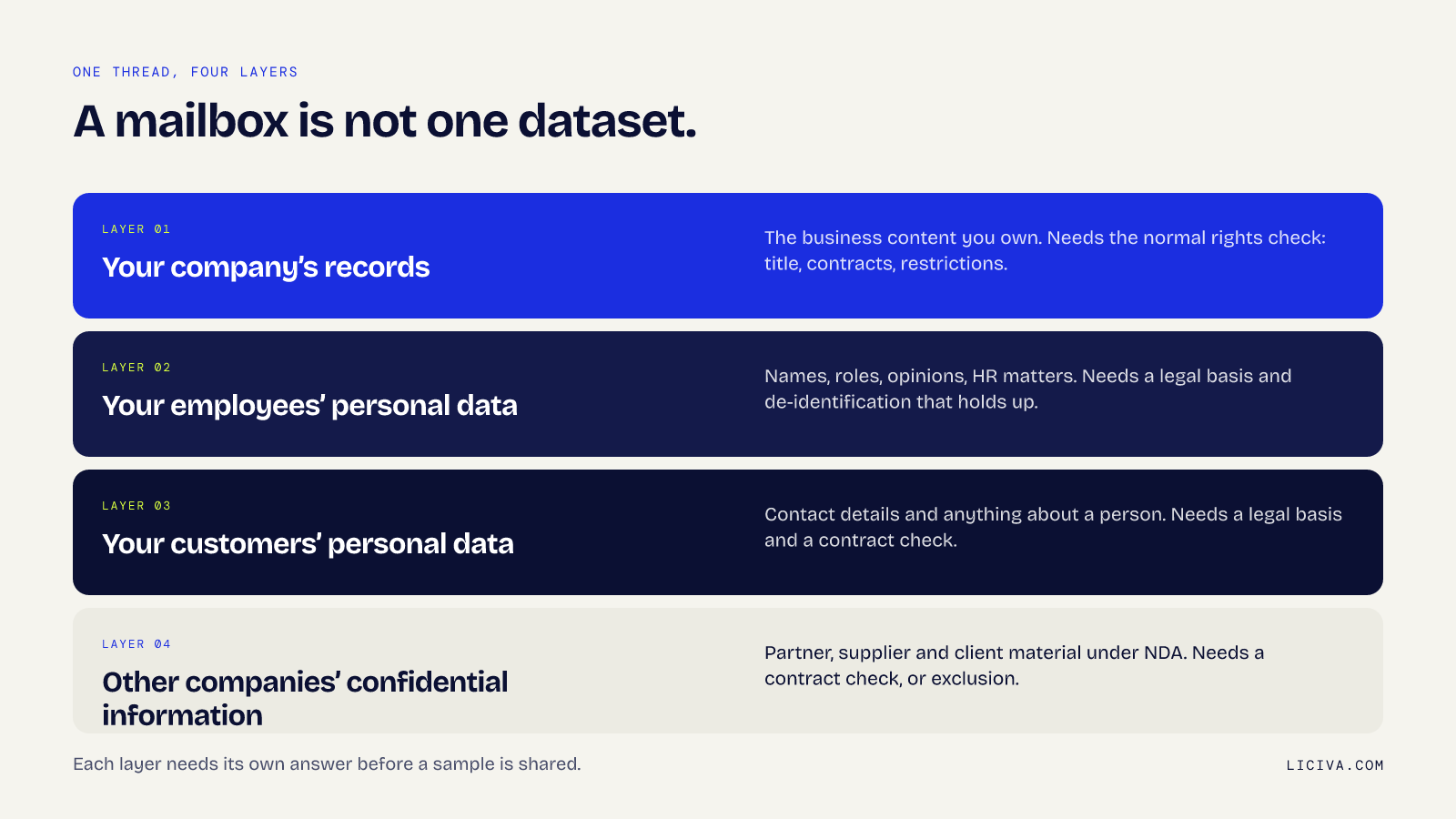
| Layer | Who it belongs to | What it needs before licensing |
|---|---|---|
| Company records: decisions, processes, how work was done | Your company | Rights check: chain of title, vendor terms, privilege, trade secrets |
| Employee personal data: names, roles, HR matters, health, pay | Your employees, protected by privacy law | Lawful basis, notice check, de-identification or exclusion |
| Customer personal data: contacts, accounts, complaints | Your customers, protected by privacy law and your contracts | Lawful basis, contract check, de-identification or exclusion |
| Third-party confidential information: NDAs, supplier documents, partner code | Other companies | Contract check, and usually exclusion |
Does your company have the right to license it?
Holding data is not the same as having the right to license it. Email and chat contain other companies’ confidential information, material covered by vendor terms, and sometimes privileged legal communications. A rights check works through chain of title, third-party terms and restrictions for the archive, and anything that fails is excluded before a licence is drafted.
A note from the law firm Frankfurt Kurnit Klein and Selz makes the point plainly: a company that holds data does not necessarily have the right to sell it. The firm lists what tends to sit inside workplace communications: other companies’ confidential information under NDAs, licensed data, open-source and vendor code, third-party copyrighted material in attachments, and data generated by vendor tools that may carry their own ownership claims. In the Spirit case, the firm notes, a software vendor objected that records generated by its platform belonged to the vendor.
The extraction route matters too. Slack’s API terms prohibit providers of applications offered outside an organisation from using API data to train a large language model, and from bulk exporting message and file data except where an additional agreement allows it. That does not decide what a workspace owner can do with its own export, but it means the route by which data leaves a platform has to be checked against the platform’s terms, not assumed.
Two more items from the same note belong on the list: a sale may waive privilege over legal communications, and it may put trade-secret protection at risk for pricing logic, strategy documents and source code. Both are reasons to exclude whole categories rather than redact line by line.
The six areas Liciva reviews are chain of title, third-party terms, personal data and consent, restrictions, use limits, and delivery and deletion. For an email archive, the first two and the fourth usually take the most time. How the rights check works is covered in its own post.
What does privacy law say about employee and customer data?
Privacy law treats the people inside the messages as rights holders in their own right. In the EU and UK, personal data needs a lawful basis and a purpose compatible with the one it was collected for, and employee consent rarely counts because of the imbalance of power. In California, employee data is inside the CCPA, and a transfer for money is a sale unless the data is de-identified to the statutory standard.
The EU and UK
The GDPR defines personal data as any information relating to an identified or identifiable natural person, including someone identifiable indirectly through factors specific to their economic, cultural or social identity. A message does not need a name to be personal data. The same regulation requires that data be collected for specified, explicit and legitimate purposes and not further processed in a way that is incompatible with them. Licensing a decade of internal communications for AI training is a new purpose, and whether it is compatible with the original one is a question your data protection lead has to answer in writing.
Consent is the basis owners reach for first, and the one regulators trust least in employment. The European Data Protection Board’s summary guidance says consent is not free if there is an imbalance of power, giving employer and employee as its example, and that an organisation must be able to show a person could refuse without detriment. The UK Information Commissioner’s Office says consent will not usually be appropriate where there is a clear imbalance of power, a particular issue for public authorities and employers. The GDPR also lets member states set specific rules for processing employees’ data, including when employee consent can be relied on, so the answer can differ between countries.
That leaves legitimate interests, which the GDPR allows except where the rights of the data subject override them, and genuine anonymisation, which takes data out of scope. Most lawful deals rest on one of those two, or both, and on a documented assessment.
The United States
There is no single federal privacy law covering workplace data, the gap Professor Ajunwa points to in the Business Insider piece. State law fills part of it. California’s privacy regulator confirms that the CCPA’s requirements apply to businesses’ processing of employees’ personal information, and the Attorney General’s guidance sets out the rights that follow: the right to know, to delete and to opt out of the sale or sharing of personal information. The Frankfurt Kurnit note adds that a transfer of workplace data for money is a sale under the CCPA unless the data meets the statute’s definition of de-identified, which requires technical measures, a public commitment not to re-identify and contractual obligations on recipients, and that internal data can also fall under HIPAA, GLBA, biometric and call-recording laws.
| Question | EU and UK (GDPR, UK GDPR) | California (CCPA) |
|---|---|---|
| Is a message with the name removed still regulated? | Yes if anyone is identifiable, directly or indirectly | Yes unless it meets the statutory de-identified standard |
| Can we rely on employee consent? | Rarely; regulators cite the imbalance of power | Not the main test; the sale, notice and opt-out rules apply |
| Is licensing for AI training a new purpose? | Yes; compatibility with the original purpose must be assessed | Notice at collection and privacy policy must have covered it |
| What takes data out of scope? | Anonymisation that holds up | De-identification with technical, public and contractual safeguards |
Do the notices in force when the data was collected allow this?
The notice that governs a message is the one in force when it was written, not the one you publish next month. Most employee handbooks and customer privacy policies never contemplated licensing communications for AI training. Changing the policy quietly and applying it backwards is a recognised deceptive practice, so historic data needs consent or a lawful alternative.
The US Federal Trade Commission put this in writing in February 2024: it may be unfair or deceptive for a company to adopt more permissive data practices, such as sharing data with third parties or using it for AI training, and to inform people only through a surreptitious, retroactive amendment to its terms or privacy policy. The post cites earlier FTC actions against companies that changed privacy policies to allow sharing with third parties without telling the people affected.
The Frankfurt Kurnit note draws the practical line: for data already collected, a company is bound by its prior commitments unless it obtains consent; for data collected going forward, such as a recurring feed, notices can be updated prospectively and opt-in consent obtained where appropriate. A licence of an archive and a licence of a live stream are different deals with different paperwork.
Is de-identification enough?
Removing names is not anonymisation. Regulators treat data with direct identifiers stripped but the rest intact as pseudonymised, which is still personal data. Message content, job titles, dates and the links between messages can identify a person, and a disciplinary thread stays sensitive with the name gone. Anonymisation has to be designed, tested and documented.
The ICO’s anonymisation guidance is direct about the common mistake. Pseudonymous information is still personal data and the law applies to it; replacing names with reference numbers reduces the link between people and their data but does not remove it, and datasets are routinely called “anonymised” when they are only pseudonymised. The same guidance notes that “de-identified” is used elsewhere to mean exactly this removal of direct identifiers, which is why the word should make a buyer ask what was actually done.
Unstructured text is harder than a spreadsheet. The Frankfurt Kurnit note observes that stripping identifying detail from millions of messages is far harder than removing names from structured fields, and that de-identification addresses whether a record links to a person, not whether its content is confidential. It also names the trap at the heart of this market: buyers want records to stay linked to each other, because the links are what make the data valuable, and the links are also what make it possible to draw conclusions about individuals or small groups. The flight attendants’ union made the same point, as Wired reported: the privacy architecture of the transaction was consumer-facing while its payload was employee-facing.
So the standard is not “names removed”. It is: identifiers removed or replaced, sensitive categories excluded outright, quasi-identifiers such as role, location and date generalised or dropped, a re-identification test run on the result, and the method written down.
How do you prepare email and chat data for licensing?
Preparation runs in five stages, in order: inventory what you hold, settle the lawful basis for each layer, exclude or de-identify what cannot be licensed as it stands, test the result against re-identification, and only then share a small sample under a signed NDA. Nothing leaves your systems before the gate at the end of stage four.
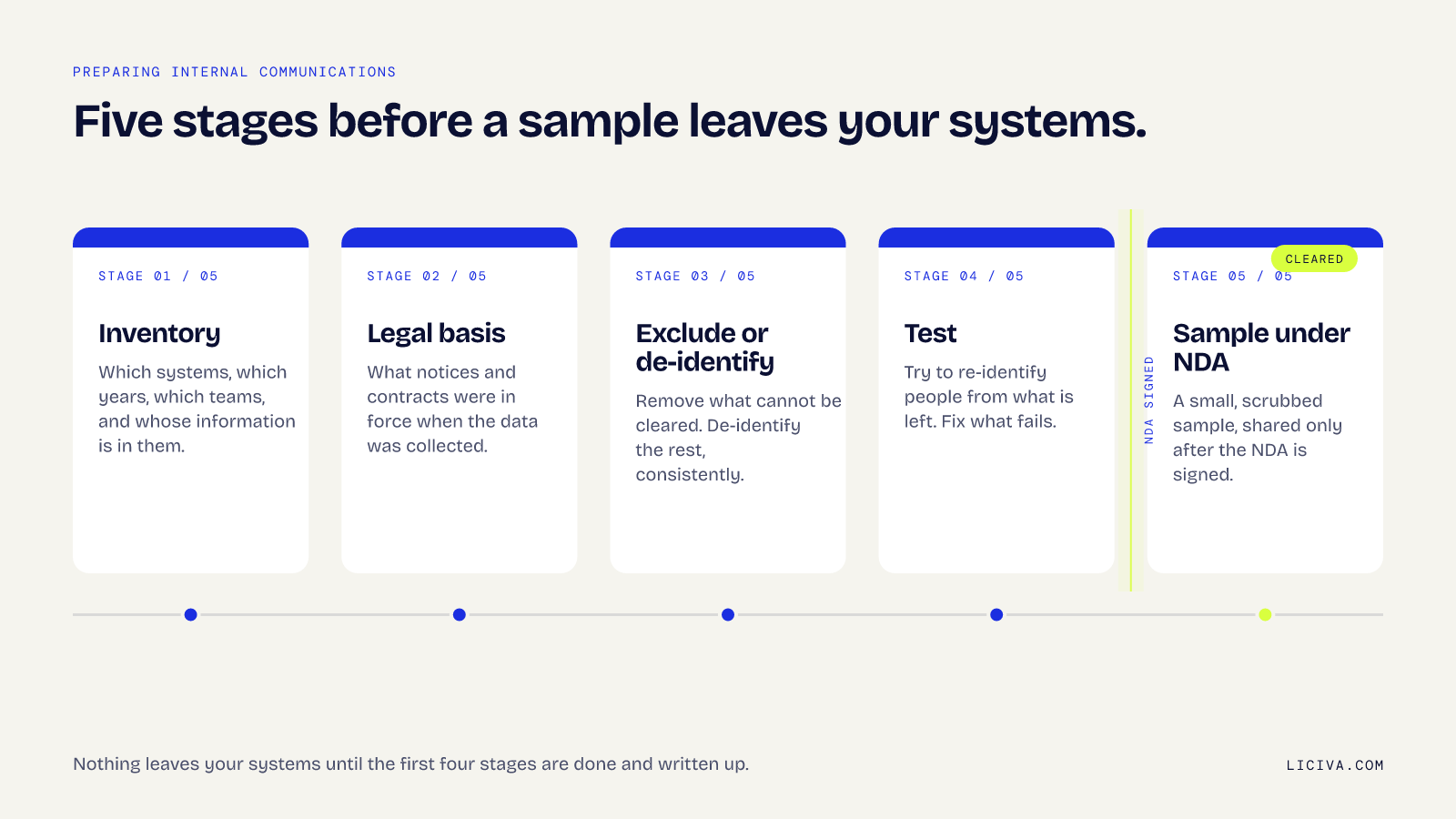
- Inventory. Which systems, date ranges, countries and teams. Note where the data lives, whether a vendor holds it and what the vendor’s terms say about export. Mark anything held on behalf of a customer as a processor rather than as your own record.
- Legal basis, layer by layer. For employee data, decide whether you rely on legitimate interests with a documented assessment, on anonymisation, or on a national employment rule. For customer data, read the contracts and the notice that applied at the time. For third-party confidential information, read the NDAs. Write the conclusion down for each layer.
- Exclude or de-identify. Exclude whole categories first: HR files, health and accommodation matters, pay and disciplinary threads, privileged communications, anything under a third-party NDA, source code with unclear licences. Then de-identify what remains, content included, not only headers.
- Test. Run a re-identification exercise on the prepared set using the additional information your own company holds, because that is the test the ICO’s definition sets. Fix what fails. Record what was done and the residual risk.
- Sample under NDA. Share a small, representative sample, scrubbed of personal data, only after a mutual NDA is signed. The sample is for judging value and fit; the licence covers training.
A short checklist for whoever runs it:
- Do we have the right to license each layer, including under the vendor terms for the export route?
- Which privacy notice governed each date range, and did it cover this use?
- Which lawful basis are we relying on for employees, and is the assessment written down?
- Have we excluded HR, health, pay, disciplinary, privileged and third-party-confidential material outright?
- Has de-identification been tested against what we ourselves hold, and is the method documented?
- Is the NDA signed before any sample moves?
What must the licence say?
The licence carries the privacy work forward into the buyer’s hands. At minimum it names the permitted uses, bans re-identification, bans resale, publication and redistribution, limits access to named staff, sets a term, and requires deletion of every copy at term end with a signed certificate. Without those terms the de-identification you did is a hope, not a control.
These are not exotic clauses. Every Liciva licence names the exact permitted uses, bans publishing, reselling or showing the files to end users, bans any attempt to re-identify a person, requires safeguards so a model does not repeat records word for word, and ends with deletion of every copy within 30 days of the term, backups cleared on rotation and a signed deletion certificate. The owner can exclude a named competitor or a whole category of use. The licence is what makes the CCPA’s “contractual obligations on recipients” real for this dataset.
Two terms deserve a specific mention for communications data. First, a ban on using the data to profile, evaluate or draw inferences about identifiable groups of workers, the protection the congressional letter on the Spirit sale asked for. Second, a term on what happens to models trained during the licence period. Whether a trained model stays in use after the data is deleted is the owner’s call, and it belongs in the licence.
When is the answer no?
Sometimes the answer is no, or not yet. The archive is held for a customer as a processor. The lawful basis cannot be documented. The notices in force ruled this use out and consent cannot realistically be obtained. The material is mostly HR, health, legal or third-party confidential content. Or the de-identification fails its own test. In each case the deal stops at the rights check.
That is why the check comes before the licence. In Liciva’s five steps the rights check is step three, after the NDA and the sample, and the home page says plainly that if personal data cannot be cleared, it isn’t licensed. A clean “no” early costs an owner a few weeks of review. A “yes” that falls apart later costs a regulator’s attention, an employee dispute and a buyer who has to retrain.
There is also a middle path. Many archives contain a core that can be licensed cleanly once the sensitive categories are carved out: process documentation, decision records, de-identified support interactions, product discussions. Often that core is what the buyer wanted in the first place.
For communications data the rights memo records the legal basis for each layer, how de-identification was done and whether it holds up. You approve every permitted use before anything is signed, and your company is never named as the source without your OK. The general route for licensing company data to AI companies has its own post.
This article is general information, not legal advice. Employment and privacy rules differ by country and by state, and the right answer for your archive depends on what it holds and what your notices said.
If you hold years of email, chat or support history and want to know which parts of it could be licensed, start with a confidential call. No specifics on the first call, and the NDA comes next.
Tags
Questions
Is it legal to license employee emails and Slack messages to an AI company?
It can be, but not as one block. A mailbox holds your company's records, your employees' personal data, your customers' personal data and other companies' confidential information. Each layer needs its own answer on rights, legal basis and contracts, and anything that cannot be cleared has to be excluded or de-identified before a licence is signed.
Can we rely on employee consent?
Usually not on its own. UK and EU regulators say consent is rarely freely given where there is an imbalance of power, and employment is their standard example. Most deals rest on a different lawful basis, on genuine anonymisation, or on both, and on checking what the privacy notices in force at the time of collection actually said.
Is removing names enough to make the data anonymous?
No. Regulators treat data with names stripped but other identifying detail left in as pseudonymised, which is still personal data. Message content, roles, dates and the links between messages can identify people. Anonymisation has to be designed, tested against re-identification and documented.
Does the CCPA apply to a licence of employee data?
In California, yes. The CCPA's requirements apply to businesses' processing of employees' personal information, and a transfer for money counts as a sale unless the data meets the statutory definition of de-identified. That brings notice, opt-out and other obligations with it.
What happens to the data when the licence ends?
In a Liciva licence, every copy is deleted at term end, backups are cleared on rotation and the owner receives a signed deletion certificate. Whether a model trained during the term stays in use is settled in the licence, and the owner decides.
What does Liciva need from us before anything is shared?
Nothing confidential. The first step is a short call with no specifics, then a mutual NDA. Only after that do we ask for a small, representative sample with personal data removed, and the rights check comes before any licence is drafted.
Related posts
Have data, or need it?
Both conversations start under NDA. Tell us what you hold, or what your model needs, and we come back with a clear next step.