EU AI Act training data requirements: what AI teams need from every data supplier
The EU AI Act training data requirements, translated into the documents an AI team should get from a data supplier before signing: sources, rights, opt-outs, personal data.
The EU AI Act asks two things of the data behind a model. Providers of general-purpose AI models must run a copyright policy that honours reservations of rights and must publish a summary of their training content using the Commission’s template. Providers of high-risk AI systems must be able to show where their training, validation and testing data came from and how it was prepared. For a sourcing lead, that turns into a short list of documents a data supplier should be able to hand over before anyone signs.
What does the EU AI Act require for training data?
The Act does not approve or ban datasets. It makes model providers accountable for knowing and disclosing what their data is, where it came from and what rights attach. Two sets of rules matter: Article 53 for general-purpose AI models, and Article 10 for high-risk AI systems. Both are easier to meet with licensed, documented data.
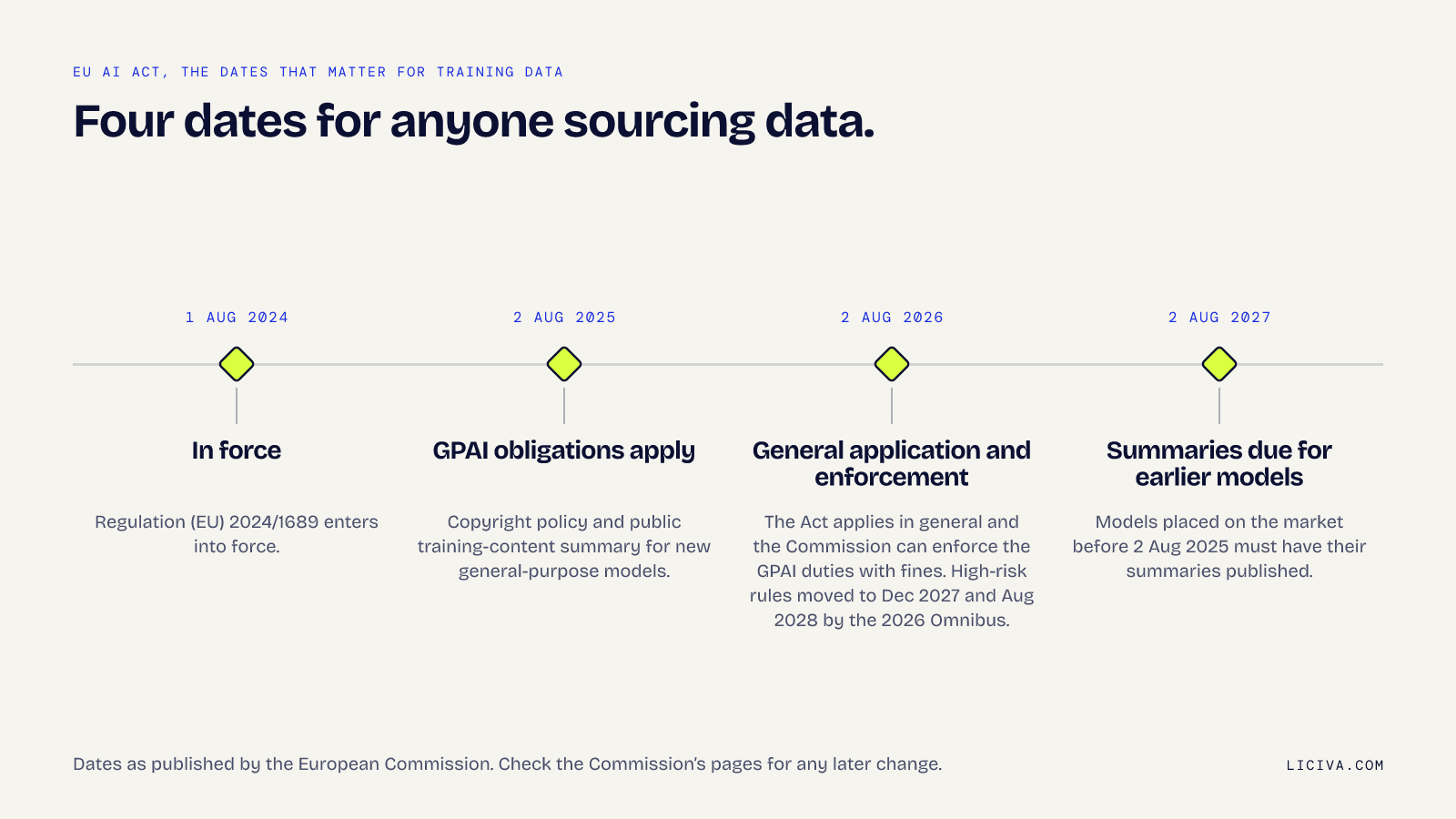
The Regulation is Regulation (EU) 2024/1689. It entered into force on 1 August 2024 and applies in general from 2 August 2026, with staggered dates for different chapters. Two definitions carry the weight:
- A general-purpose AI model is an AI model that displays significant generality, can perform a wide range of distinct tasks and can be integrated into many downstream systems. The definition is in Article 3(63) and is quoted on the Article 53 page.
- A provider is the person or body that develops an AI system or a general-purpose AI model, or has one developed, and places it on the market or puts it into service under its own name, whether for payment or free of charge. That is Article 3(3), quoted on the Article 2 page.
Train a model that fits the first definition and place it on the EU market, and Article 53 applies to you. Build a system in one of the high-risk categories, and Article 10 applies to the data you train, validate and test it with.
When do the training data rules apply?
The obligations for providers of general-purpose AI models have applied since 2 August 2025. The Commission’s enforcement powers, including fines, apply from 2 August 2026. Models placed on the market before 2 August 2025 must comply by 2 August 2027. The high-risk data governance rules were pushed back by the 2026 Digital Omnibus to December 2027 and August 2028.
The dates come from Article 113 and the Commission’s guidelines page for GPAI providers:
- 1 August 2024. The Regulation entered into force, twenty days after publication in the Official Journal.
- 2 August 2025. Chapter V, which contains the Article 53 obligations, started to apply, including the duty to publish a training content summary.
- 2 August 2026. The Regulation applies in general, and the Commission’s power to enforce the GPAI obligations with fines starts. Its Code of Practice Q&A says that from this date it enforces full compliance.
- 2 August 2027. Providers of general-purpose AI models placed on the market before 2 August 2025 must comply, including publishing their summaries.
One change arrived in 2026. The Digital Omnibus on AI amended the Act, and the amended Article 113 now applies the high-risk rules in Chapter III from 2 December 2027 for stand-alone high-risk systems under Annex III, and from 2 August 2028 for high-risk systems embedded in products under Annex I. Orrick’s summary of the Omnibus confirms the amendments are published in the Official Journal and in force, and that the previous Annex III date was 2 August 2026. The general-purpose AI obligations were not moved.
Does the Act apply to AI teams outside the EU?
Yes. Article 2 applies the Regulation to providers placing AI systems or general-purpose AI models on the EU market, or putting AI systems into service in the EU, irrespective of whether those providers are established in the EU or in a third country. A lab in San Francisco or Singapore that offers a model to EU customers is in scope.
The wording in Article 2(1)(a) is direct: the Regulation applies to providers placing AI systems or general-purpose AI models on the market in the Union, “irrespective of whether those providers are established or located within the Union or in a third country”. There are carve-outs, for example for exclusively military, defence or national security uses, but none for being foreign. So the training data record you keep has to support a public summary in the EU, even if the data was collected and the model trained elsewhere.
What does Article 53 ask of general-purpose model providers?
Article 53 requires technical documentation for the AI Office, documentation for downstream providers, a copyright policy that respects reservations of rights, and a public summary of training content. The copyright policy and the public summary apply to every general-purpose model provider, including those releasing open-source models.
The text of Article 53(1) lists four duties:
- (a) technical documentation of the model, including its training and testing process, with at least the content in Annex XI, for the AI Office and national authorities on request;
- (b) information for providers of AI systems who integrate the model, with at least the content in Annex XII;
- (c) put in place a policy to comply with Union copyright law, and in particular to identify and comply with, including through state-of-the-art technologies, a reservation of rights expressed under Article 4(3) of Directive (EU) 2019/790;
- (d) draw up and make publicly available a sufficiently detailed summary of the content used for training, according to a template provided by the AI Office.
Paragraph 2 exempts open-source models from (a) and (b), but not from (c) and (d), and not at all if the model carries systemic risk.
Why a reservation of rights matters to your data supplier
Duty (c) points at the text and data mining exception in the 2019 copyright directive. Article 4 of Directive (EU) 2019/790 lets anyone make reproductions and extractions of lawfully accessible works for text and data mining, but paragraph 3 says the exception applies only where the rightholder has not expressly reserved that use “in an appropriate manner, such as machine-readable means in the case of content made publicly available online”. The recitals add that for online content, the appropriate way to reserve rights is machine-readable means, including metadata and a site’s terms and conditions.
So a scraped corpus has a question hanging over every page: did the rightholder opt out, and did you respect it? A licensed dataset answers that in the contract. The licensor grants the training use directly, so no exception is needed for the material it owns, and it should be able to say what rights it holds in any third-party material inside the dataset.
What goes into the public summary of training content?
The Commission’s template is mandatory and has three sections: general information about the provider, the model and the modalities of training content; a list of data sources, with different levels of detail for public datasets, private datasets, scraped data, user data and synthetic data; and relevant data processing aspects, such as how copyright reservations and illegal content were handled.
The template and explanatory notice are published by the Commission in all official languages. Its Q&A page explains what each section asks for:
| Section | What it asks for | What that means for licensed data |
|---|---|---|
| General information | Provider, model, types of training content, size per modality within broad ranges, general characteristics | Supplier states modality, approximate size and field in the data documentation |
| List of data sources | Public datasets, private datasets from third parties, scraped data, user data and synthetic data, each at its own level of detail. Scraped data: crawler names, collection period, content description, top domains | A licensed private dataset is described in general terms. The owner’s name is not required, but you must know what it is and how it was acquired |
| Relevant data processing aspects | Information that lets rightholders exercise their rights under Union law, and the removal of illegal content | The supplier’s record of de-identification, filtering and opt-out handling feeds this section |
One point from the Q&A deserves attention: the template “requires different levels of detail depending on the data source to protect providers’ trade secrets”. A private, licensed dataset is treated differently from a scraped one.
What does Article 10 require for high-risk systems?
High-risk AI systems trained with data must be built on training, validation and testing datasets that follow data governance practices appropriate for the intended purpose. The practices cover design choices, data origin and collection, the original purpose of any personal data, preparation steps, assumptions, suitability, bias examination and mitigation, and known data gaps.
The current text of Article 10 lists the practices in paragraph 2. The ones a data supplier can directly support are:
- (b) data collection processes and the origin of data, and for personal data, the original purpose of collection;
- (c) the data-preparation operations, such as annotation, labelling, cleaning, updating, enrichment and aggregation;
- (e) an assessment of the availability, quantity and suitability of the datasets needed;
- (h) the identification of data gaps or shortcomings and how they can be addressed.
Paragraph 3 adds that the datasets must be relevant, sufficiently representative and, to the best extent possible, free of errors and complete in view of the intended purpose. The Article 10 page marks the text as amended by the Omnibus, and its former paragraph 5 on processing special categories of personal data for bias detection is no longer in the article, so check the consolidated text with counsel.
For a buyer, point (b) matters most. If your supplier cannot say how the data was collected and, for personal data, why it was originally collected, you cannot write the Article 10 record.
Is the GPAI Code of Practice mandatory?
No. The General-Purpose AI Code of Practice is a voluntary tool prepared by independent experts. Article 53(4) lets providers rely on a code of practice to demonstrate compliance until a harmonised standard exists. Providers who do not sign must show adequate alternative means of compliance to the Commission.
The Code was published on 10 July 2025 and has three chapters: Transparency and Copyright, for all providers of general-purpose AI models, and Safety and Security, only for providers of models with systemic risk. The Commission and the AI Board have confirmed it is an adequate voluntary tool for demonstrating compliance.
Signing is optional. Keeping a defensible data record is not.
What should a data supplier hand over?
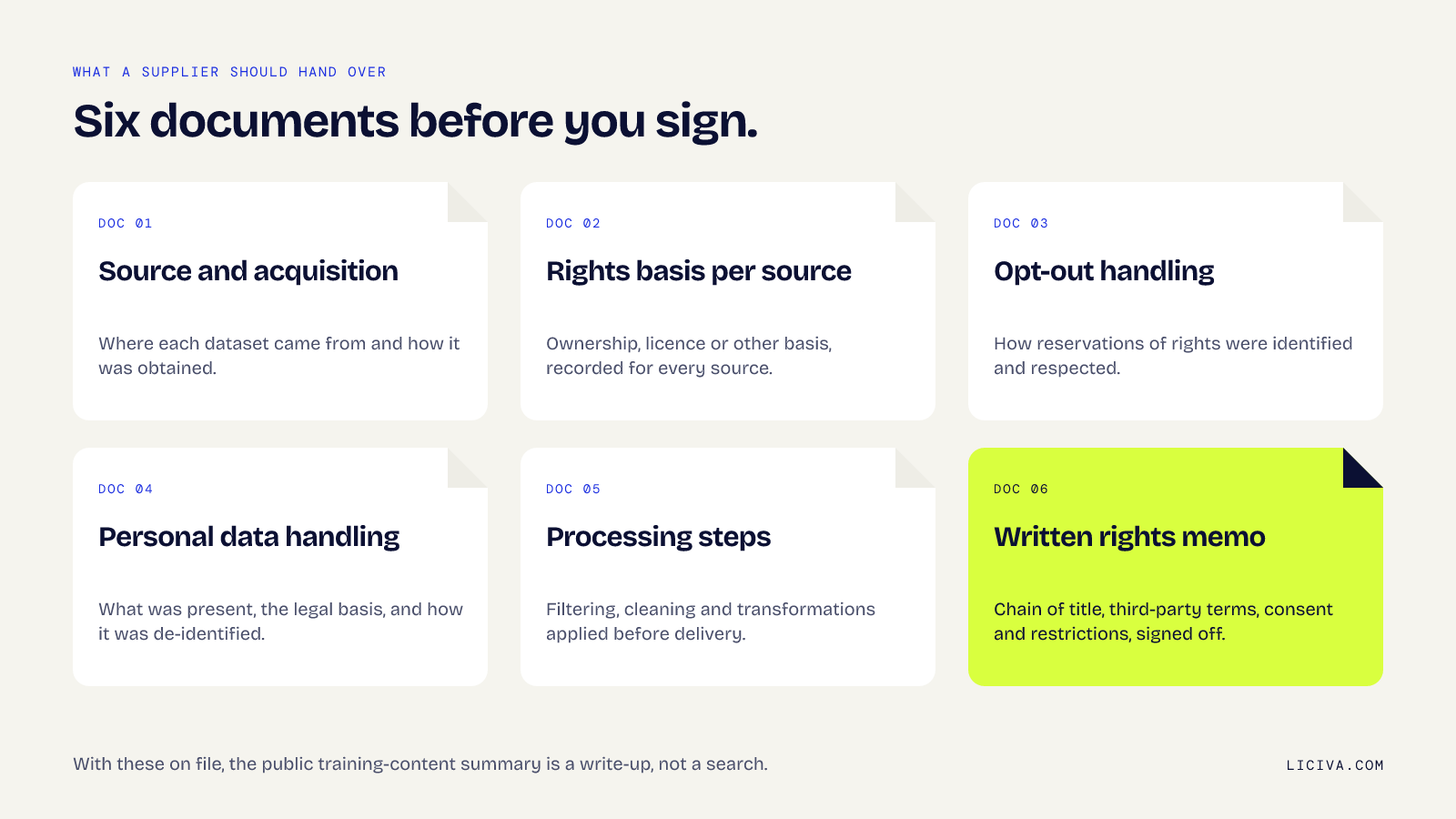
Six documents cover the training data parts of Article 53 and Article 10: a source and acquisition record, a rights basis for each source, a record of opt-out handling, a personal data statement, a processing log, and a written rights memo. Ask for them before the sample stage, not after signing.
| Obligation | What it needs | Document from the supplier |
|---|---|---|
| Public summary, list of sources (Art. 53(1)(d)) | Where each dataset came from and how | Source and acquisition record: system of origin, date range, collection method, any scraped part |
| Copyright policy (Art. 53(1)(c)) | A basis for using each piece of content | Rights basis per source: owned, licensed in, open-licensed or public domain, with the contract reference |
| Reservation of rights (Art. 53(1)(c), Directive 2019/790 Art. 4(3)) | Proof that machine-readable opt-outs were respected | Opt-out handling: signals checked and material excluded for any scraped part; a statement that none applies to owned data |
| Processing aspects (Art. 53(1)(d)) and Art. 10(2)(b) | Whether personal data is present and on what basis | Personal data handling: categories, legal basis, de-identification method and how it was tested |
| Art. 10(2)(c) | Preparation operations | Processing log: cleaning, filtering, annotation, enrichment, aggregation, with dates and tools |
| Technical documentation (Art. 53(1)(a)), Art. 10(2)(e) and (h) | A conclusion you can file | Written rights memo: who owns the data, what restricts it, what is excluded, what the licence grants |
The last row is the one most suppliers cannot produce. A rights memo is a written conclusion, not a warranty clause: who created the data, who holds the rights, what limits it, whether consent and de-identification hold up. The six areas Liciva reviews in every rights check map onto the table: chain of title, third-party terms, personal data and consent, restrictions, use limits, and delivery and deletion.
Checklist: questions to ask a supplier before you sign
Ask these in writing and keep the answers with the licence. Any gap is what you will have to explain in your own documentation.
- Who created this data, and who owns it now? Can you show the chain of title?
- Was any part scraped from the open web? Which crawlers, over which period, and how were machine-readable reservations of rights handled?
- Does it contain third-party material, such as customer documents, vendor content or open-source code? On what basis is each included?
- Does it contain personal data? What was the original purpose of collection, what is the legal basis for licensing it, and how was de-identification done and tested?
- Do contracts, confidentiality duties, export controls or sector rules restrict it? Which records were excluded as a result?
- What processing was applied between the source systems and the delivered files?
- Can you deliver a written rights memo we can rely on in our technical documentation?
- Will you cooperate if we update our public summary, answer the AI Office or a national authority, or respond to a rightholder?
- How long will you keep the supporting records, and can we get copies?
- Can we evaluate a sample under NDA before we commit?
Liciva’s five-step process gives each of these an answer before the licence exists: NDA, scrubbed sample, rights check and memo, scoped licence, then logged delivery and certified deletion at term end.
What should the licence say?
The licence should carry the supplier’s warranties about rights and personal data, a duty to cooperate with your Article 53 and Article 10 documentation, a records retention period, and the delivery and deletion terms. It should set the permitted uses precisely, because your summary will describe them.
The clauses that do real work under the Act:
- Rights warranty tied to the memo. The licensor warrants that it holds the rights it grants, with the rights memo attached so the warranty has something concrete behind it.
- Reservation of rights warranty. For any scraped component, that machine-readable reservations were identified and respected, with the method described.
- Personal data warranty. What is present, the legal basis, the de-identification method, and a duty to tell you if that position changes.
- Cooperation duty. Help with your public summary, your technical documentation and any response to the AI Office, a national authority or a rightholder, during the term and for a defined period afterwards.
- Records retention. Both sides keep the source, rights and processing records for a stated period after the licence ends.
- Permitted uses, delivery and deletion. Pre-training, fine-tuning or evaluation named precisely; encrypted, logged delivery; deletion at term end with a certificate.
None of this is exotic. It is the paperwork a careful licensor already produces, written so that a buyer can file it.
How does licensed data make the summary easier?
A licensed, documented dataset arrives with its sources, rights and processing already written down. The three sections of the public summary and the Article 10 practices can be filled from that record. Scraped data has to be reconstructed after the fact, source by source, and the opt-out question is open for every page.
With a scraped corpus, the source list must be rebuilt from crawl logs, the top domains listed, and opt-out handling shown site by site. With a licensed private dataset, the summary describes it in general terms, the contract grants the training use, and the owner stays unnamed unless they agree.
This is the reason Liciva publishes what its rights check covers rather than a general promise. Every deal starts under NDA, the sample is scrubbed of personal data before it is shared, and the rights memo is written before any licence is drafted. The memo is the document your counsel reads, and the document your Article 53 summary is built from. If the rights cannot be cleared, the data is not licensed.
Two related posts go deeper: what data provenance means for AI training, and how a rights check works in practice.
This article is general information, not legal advice. The Act is still being amended and interpreted, so confirm the current consolidated text with counsel before relying on any date or obligation.
Source data you can actually defend
If your model will reach the EU market, the cheapest time to get the paperwork right is before the sample arrives. Tell us what your model needs and we come back with licensed, documented data and a rights memo your counsel can rely on. Samples come under NDA, so you can evaluate before you commit. Start a sourcing request.
Tags
Questions
Does the EU AI Act apply to an AI company based outside the EU?
Yes, if it places an AI system or a general-purpose AI model on the EU market or puts one into service in the EU. Article 2 says the Regulation applies to providers irrespective of whether they are established in the EU or in a third country.
What training data information must a general-purpose AI model provider publish?
A public summary of the content used to train the model, using the Commission's mandatory template. It has three sections: general information, a list of data sources, and relevant data processing aspects. Private datasets obtained from third parties must be described in general terms, and large public datasets listed.
When did the training data obligations for general-purpose AI models start to apply?
On 2 August 2025. Models placed on the EU market before that date have until 2 August 2027 to comply. The Commission's power to enforce the obligations with fines applies from 2 August 2026.
Did the Digital Omnibus change the training data rules?
It moved the high-risk deadlines. Obligations for stand-alone high-risk systems under Annex III now apply from 2 December 2027, and for high-risk systems embedded in regulated products under Annex I from 2 August 2028. The general-purpose AI obligations in Article 53, including the training content summary, were not postponed.
What should an AI team ask a data supplier for under the EU AI Act?
A record of each source and how it was acquired, the rights basis for each source, how any reservation of rights or opt-out was handled, what personal data is present and on what legal basis, a log of processing steps, and a written rights memo. Those documents are what the public summary and the copyright policy are built from.
Is the General-Purpose AI Code of Practice mandatory?
No. It is a voluntary tool. Providers who sign it can use it to show compliance with Article 53, and the Commission and the AI Board have confirmed it is an adequate way to do so. Providers who do not sign must show compliance by other means.
Related posts
Have data, or need it?
Both conversations start under NDA. Tell us what you hold, or what your model needs, and we come back with a clear next step.