Best AI training data providers in 2026: how they compare
The best AI training data providers for each job: labeling, expert data, ready-made datasets and licensed company data. 15 providers compared on what they publish about sourcing and licences.
The best AI training data provider depends on the job. For labels on data you already hold, use a labeling or data-services firm; for new data made by specialists, an expert-data firm; for something ready to use this week, a catalogue or marketplace; for real records that exist only inside companies, a licensed-data provider. Within each group, prefer the provider that can show you where the data came from and what licence you get.
The best AI training data providers, compared
The table groups the 15 providers by their main offer to AI teams. Many sell in more than one category. The last two columns record what each publishes about sourcing and about the licence you receive, because those are what your counsel will ask for. “Not published” means we did not find it on the pages we checked.
| Provider | Main category | Main offer to AI teams | Published on sourcing and consent | Buyer licence terms public? |
|---|---|---|---|---|
| Appen | Labeling, data services, catalogue | 646-dataset catalogue, custom collection and annotation, RLHF, RL environments | Spec sheet per dataset: source, consent, annotation method, licence | Standard catalogue licence stated |
| Defined.ai | Marketplace and data services | Off-the-shelf datasets by API, custom collection, annotation, RLHF | Contributor consent; suppliers vetted for licensing rights | Yes, Data License Agreement |
| Scale AI | Data services | Training data from sourced contributors, evaluations, leaderboards | Not published on pages checked | Not published |
| Labelbox | Expert data and environments | RL environments and evals, robotics data, expert network | Prism provenance step described | Not published |
| Surge | Expert data | Custom data, off-the-shelf datasets, RL environments, benchmarks | Not published on pages checked | Pilot and benchmark terms of sale |
| Mercor | Expert data | Expert network, human evaluation, benchmarks, RL environments | Not published | Not published |
| micro1 | Expert data | Expert human data, RL environments, evaluations, robotics data | Owner warranties in public licence terms | Not published |
| Handshake AI | Expert data | Expert network, datasets, RL environments | Not published | Not published |
| Turing | Expert data and datasets | Custom and off-the-shelf datasets, RL environments, experts | “Traceable QA” | Not published |
| AfterQuery | Expert data | SFT and RL data, agent environments, RLHF, catalogue on request | Not published | Not published |
| Snorkel | Expert data | Curriculum datasets, custom datasets, evals, environments | Audit trail for every label | Not published |
| DataVendor | Marketplace | Codebases, tasksets, RL environments; post a brief | Automated secrets, personal-data and claim checks | Yes, buyer agreements |
| Grepped | Licensed company data | Company archives and code, packaged to spec | Every source licensed under a signed owner agreement | Not published |
| Protege | Licensed real-world data | Healthcare, media, audio and spatial data; custom cohorts | De-identification for healthcare data; samples before licensing | Default buyer licence in provider terms |
| Ooak Data | Licensed company data | Anonymised “digital twins” and RL environments | Anonymisation method published | Not published |
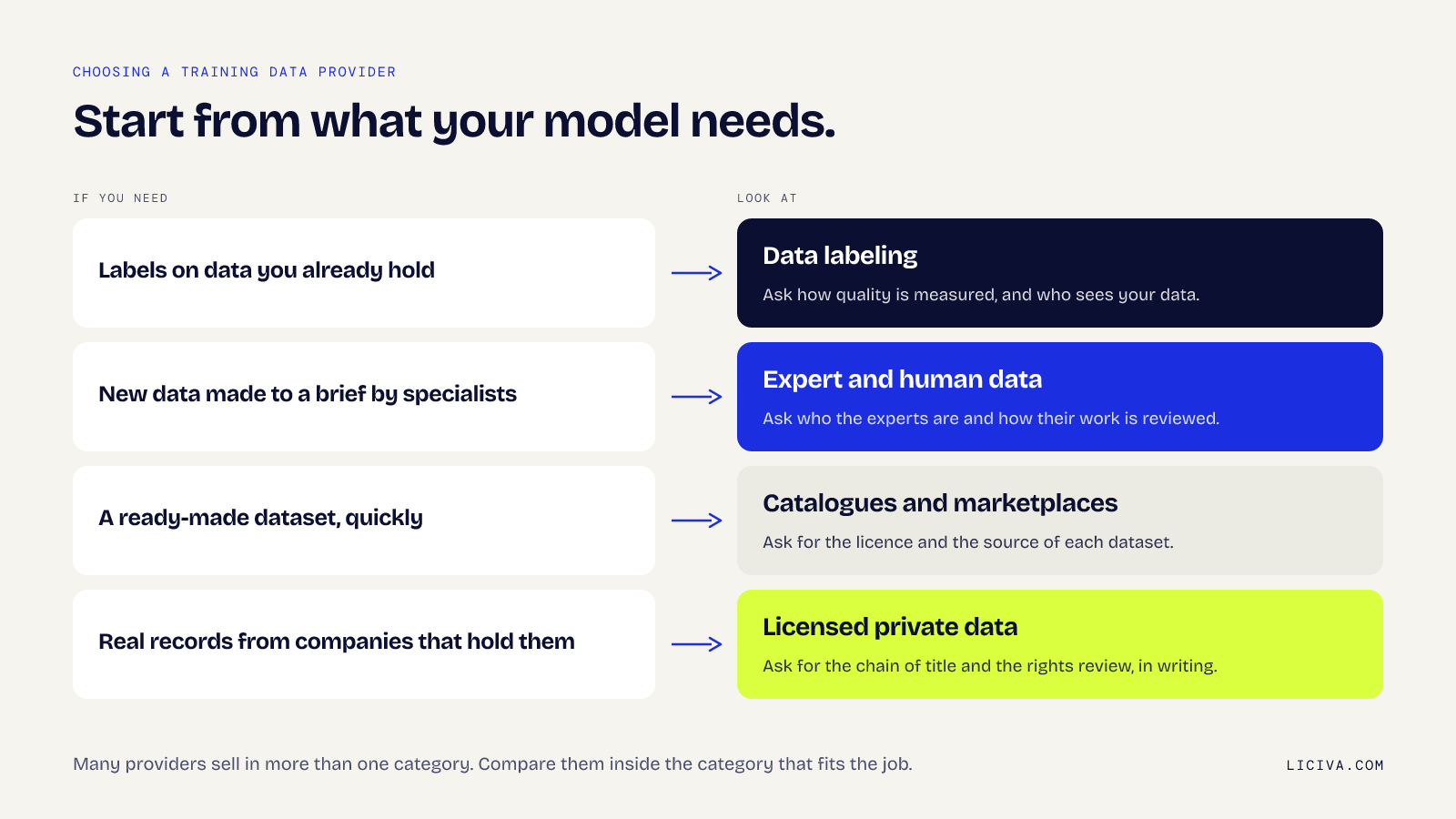
Which kind of provider do you need?
Start from the job, not the brand. A labeling firm cannot give you records it does not have, and a licensed-data provider will not label your data. If you are not sure which job you have, the category explainer walks through the difference.
Best for labels and data services on your own data
These firms suit teams that already hold the raw data and need it collected, annotated or reviewed to a specification, at volume.
- Appen offers custom collection and annotation, RLHF from subject experts, red teaming and RL environments. Its catalogue lists “646 datasets across nine categories”, each with a “spec sheet documenting source, consent, annotation method, known limitations, and license terms”. It says the standard licence is perpetual and non-exclusive with commercial training rights, that samples are available under NDA for most datasets, and that consent records and lineage are produced in a form that supports EU AI Act technical documentation. Best for teams that want one supplier for both custom work and documented catalogue data.
- Defined.ai runs a marketplace of off-the-shelf datasets, delivered by API, alongside custom collection, annotation, evaluation and LLM fine-tuning services. Its Data License Agreement is public: a non-exclusive, non-sublicensable licence for internal business operations, with models commercialisable “as long as the Data itself is not made available”. Its FAQ says contributors give consent before using the platform. Best for speech, language and multimodal datasets where you want to read the licence before you talk to sales.
- Scale AI says it sources contributors “with precision” for frontier model builders and also sells evaluations and private benchmarks. Sourcing and licence documentation for buyers was not on the pages we checked, so ask for it directly. Best for teams that want a large, established supplier and will run their own diligence.
Best for expert and human data made to a brief
These firms suit teams that need data that does not exist yet: demonstrations, preference rankings, rubrics, evaluations and RL tasks written by people with real domain skill. Most now lead with RL environments and evaluations rather than classic labeling.
- Surge sells custom training data, off-the-shelf datasets, RL environments and benchmarks “built by the same experts behind our frontier-lab work”. It publishes enterprise pilot terms of sale that bar it from selling a delivered pilot dataset to anyone else. Best for teams that want to read sale terms up front.
- Mercor runs an expert network of physicians, lawyers, engineers and consultants, with human evaluation, benchmarks and RL environments built on professional work. Its enterprise evals page covers expert staffing and production rubrics. Best for professional-domain evaluations.
- micro1 offers expert human data, RL environments, evaluations and robotics data. Its public data licence master terms show what it requires of the companies it licenses data from, including warranties against scraped and AI-generated content and seven years of consent records. Best for teams that want to see the supply-side terms behind a dataset.
- Handshake AI describes a large expert network and in-house research on data creation, RL environments, post-training and agentic grading. Best for broad expert coverage across many fields.
- Turing offers frontier labs custom and off-the-shelf datasets, RL environments and human experts. Its datasets page describes datasets with “RL environments, tasks, verifiers, and traces” and “traceable QA”. Best for agentic and coding work that needs environments and verifiers together.
- AfterQuery sells SFT data, RL with rubrics and verifiers, tool-calling and computer-use environments, RLHF and custom evaluations, and offers access to an off-the-shelf catalogue on request. Best for post-training work led by a research team.
- Snorkel sells curriculum-structured datasets with rubrics and eval slices built in, plus custom datasets, evaluations and environments. It describes an “author, multi-reviewer, and final-adjudicator pipeline with full audit trails”, so every label is traceable to who decided what and when. Best for teams that need an audit trail on the human judgements.
- Labelbox sells RL environments and evaluations, robotics demonstrations and an expert network that writes rubrics and graded assessments. Best for robotics and computer-use data alongside evaluations.
Best for ready-made datasets and marketplaces
Catalogues and marketplaces suit teams that need something this week and can accept data built for many buyers rather than one. The key question is the licence and the source of each dataset, because a marketplace is only as clean as the listing you buy.
- Appen and Defined.ai, above, both run large catalogues with published licence terms.
- DataVendor, run by HUD, sells codebases, tasksets and RL environments listed by vendors, and lets you post a brief with a budget. It says every listing is checked for secrets, personal data, integrity and rarity before it goes live. Under its vendor terms, vendors license data to HUD, which sublicenses to buyers. Best for code and agent-training material.
- Surge, Turing and AfterQuery also offer off-the-shelf datasets, described above.
Best for licensed data from the companies that hold it
These providers source records that exist only inside companies, such as support histories, operational workflows, clinical records and code, and license them to AI teams. They suit teams training on how real work is done. The question to ask is how the provider knows the company had the right to license the data.
- Grepped lists company archives, code and other corpora, packaged to your format, with samples under NDA. It says “every source is licensed under a signed agreement with the data owner”, and that personal-data handling is agreed with each owner and set out in your licence. Best for whole-company archives.
- Protege licenses healthcare, video, audio and spatial data for pre-training, post-training and evaluation. For healthcare it assembles custom cohorts by modality, geography or time range, says datasets are de-identified, and shares descriptions, metadata and samples before licensing. Best for regulated clinical and medical imaging data.
- Ooak Data sources enterprise data, anonymises it into “digital twins” and builds RL environments with expert tasks. Its anonymisation write-up describes automated leak scans and human review before release. Best for enterprise RL environments built on real company history.
A few companies focused on data owners also supply labs, but publish less for buyers: Nyne says it identifies data owners, agrees licensing and prepares datasets around your research requirements; SF Data turns production traces into RL environments; Polyshares and Endless Data license company data and supply it to labs. The owner-side comparison covers how all of them source.
Where does Liciva fit?
Liciva is one of the options for licensed data, so it is described here and not ranked. Liciva licenses existing data, in any field, from the companies that hold it to AI teams. It does not do labeling or create expert data. Its homepage describes the offer to AI teams: you say what your model needs, samples come under NDA so you can evaluate before you commit, and you sign one contract with Liciva, with a written rights memo for each dataset.
That memo covers the six areas of the rights check: chain of title, third-party terms, personal data and consent, restrictions, use limits, and delivery and deletion. Liciva claims no clients, catalogue size or figures. Weigh it on whether its documentation answers your counsel’s questions, the same test as everyone else here.
How to choose an AI training data provider
Use these steps whatever category you land in.
- Name the job. Labels on your data, new expert data, a ready-made dataset, or licensed real-world records. Shortlist inside that category only.
- Ask for the source of each dataset. Where it came from and how it was obtained. The provenance post lists the record you need for each link.
- Ask what rights the provider holds. A provider can only grant what it was granted. If it relies on its own suppliers’ warranties, ask to see how those are checked.
- Read the licence you receive. Permitted uses, term, exclusivity, what happens to trained models, and deletion. Prefer providers that publish terms or send them before a call.
- Check personal data handling. The legal basis, the de-identification method, and whether it was tested.
- Get the documents your own obligations need. If you place a general-purpose model on the EU market, you must publish a training-content summary. The EU AI Act post lists the supplier pack to ask for.
- Evaluate a sample under NDA before committing. Most providers above offer samples; make it a condition.
How we compared
We started from 19 companies that AI teams and data owners meet in this market. We kept the 15 that publish a clear offer to AI teams and noted four more that mainly serve data owners. Between 6 and 7 November 2026 we read each provider’s homepage, its pages for AI teams, and its catalogue, FAQ and legal pages where these exist. On 7 November 2026 we fetched every page again and recorded only what was stated, with a link.
For each provider we recorded the main category, the main offer, what it publishes on sourcing and consent, and whether buyer licence terms are public. We did not test any datasets, use reviews or press coverage, or contact the companies. We left out each company’s claims about its own customers, size, payouts and valuation, because we cannot check them, and we left out points where a company’s own pages disagree. “Best for” describes a fit, not a ranking. Terms change; check the linked page before you rely on anything here.
Where to start
Write one paragraph on what your model needs and what your counsel will need to see. Then shortlist two or three providers from the right category and ask each for a sample under NDA and the licence in writing. If you need licensed data from companies that hold it, send us a sourcing request and a named person will reply.
Tags
Questions
What is the best AI training data provider?
There is no single best provider, because the companies do different jobs. For labels on your own data, look at labeling and data-services firms such as Appen or Defined.ai. For new data made by specialists, look at expert-data firms such as Surge, Mercor, micro1, Turing, AfterQuery, Handshake AI or Snorkel. For ready-made datasets, look at catalogues such as Appen's, Defined.ai's or DataVendor's. For real records licensed from companies, look at Protege, Grepped, Ooak Data or Liciva.
Which training data providers publish their licence terms?
Of the 15 providers compared, as of 7 November 2026, Defined.ai publishes its Data License Agreement, DataVendor publishes its buyer agreements, Surge publishes pilot and benchmark terms of sale, Appen states its standard catalogue licence on its catalogue page, and Protege's provider terms describe the default licence its buyers receive. For the others, buyer licence terms were not on the pages we checked.
Which providers document consent and provenance?
Appen says each catalogue dataset has a spec sheet covering source, consent, annotation method and licence terms. Defined.ai says contributors consent before using its platform and that suppliers are vetted for licensing rights. Snorkel describes an audit trail for every label. DataVendor runs automated checks on every listing. Grepped says every source is licensed under a signed agreement with the owner. Most others publish little on this.
What should we ask a training data provider before signing?
Ask where each dataset came from and how it was obtained, what rights the provider holds and can grant, how personal data was handled, what licence you receive, and what records you get to support your own documentation, including the training-content summary the EU AI Act requires of general-purpose model providers.
Is Liciva a training data provider?
Liciva licenses existing data from the companies that hold it to AI teams, with a written rights check on every dataset. It does not do labeling or expert data creation. It is one of the options in the licensed-data category, which is why it is described separately here and not ranked.
Related posts
Have data, or need it?
Both conversations start under NDA. Tell us what you hold, or what your model needs, and we come back with a clear next step.