Data licensing vs data labeling vs expert data: which AI data company do you need?
Data labeling vs data licensing vs expert data, explained: what each kind of AI data company sells, what the contract covers, and how to pick the right one before comparing names.
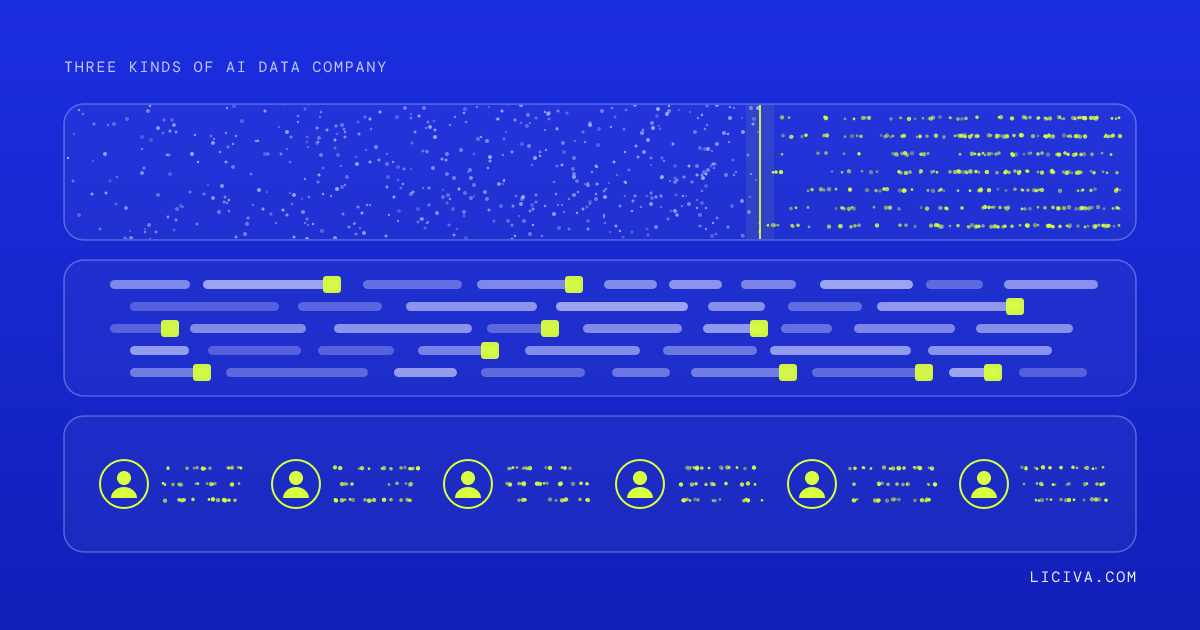
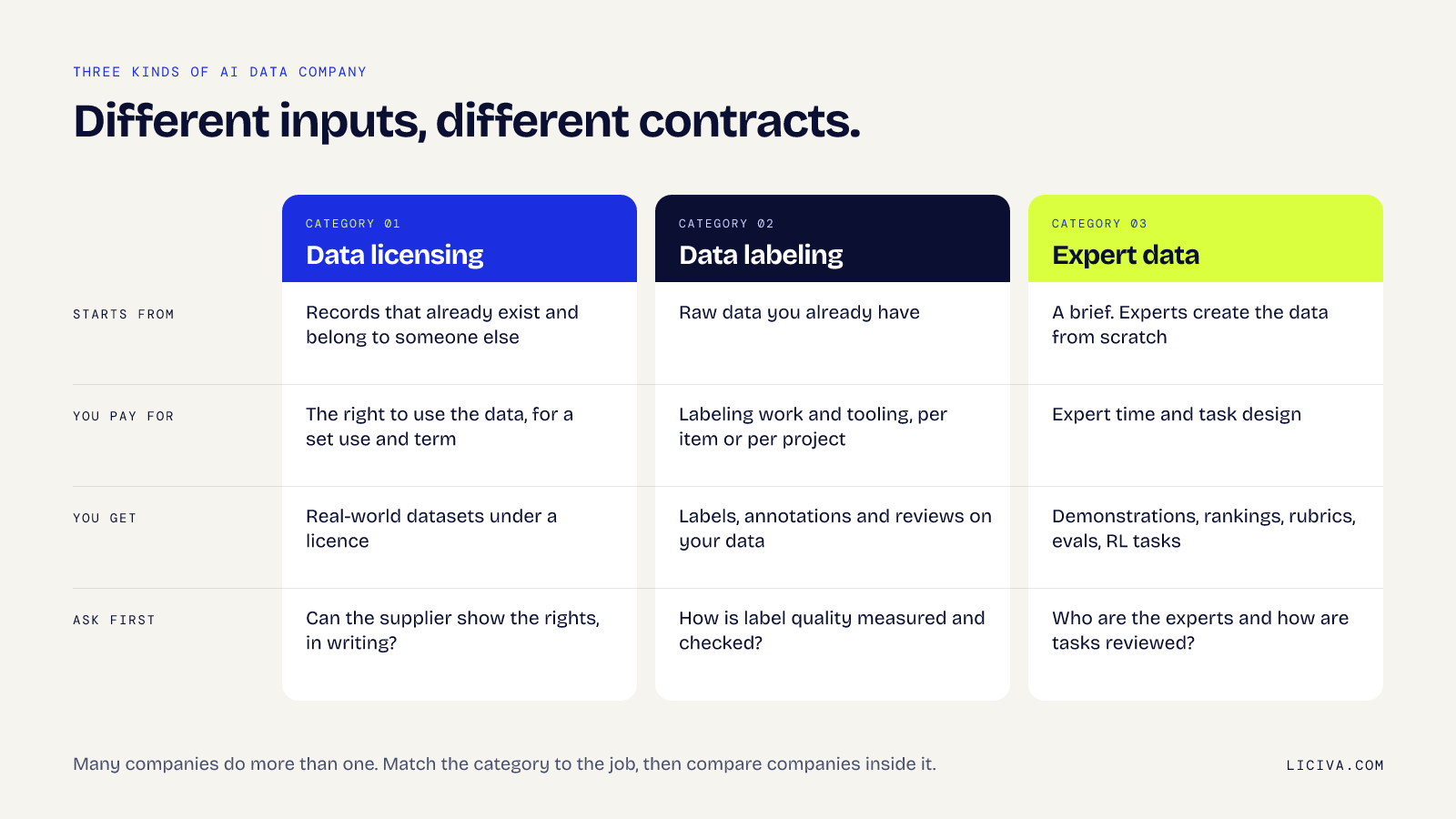
Data licensing, data labeling and expert data are three different purchases. Licensing buys the right to use records that already exist and belong to someone else. Labeling buys work on data you already hold. Expert data buys new data that specialists create to your brief. Pick the category first, because the contract, the risks and the questions to ask are different in each.
Data licensing vs data labeling vs expert data at a glance
The three categories answer different needs. Marketplaces and catalogues are a fourth thing: a way of selling data, which can hold licensed, labeled or expert-made datasets.
| Data licensing | Data labeling | Expert data | Marketplaces and catalogues | |
|---|---|---|---|---|
| You start with | A need for data you do not have | Raw data you already hold | A brief | A search for a ready-made dataset |
| You pay for | The right to use the data, for a set use and term | Labeling work and tooling | Expert time and task design | A licence to a listed dataset |
| You get | Real-world records under a licence | Labels, annotations and reviews on your data | Demonstrations, rankings, rubrics, evals, RL tasks | A dataset built for many buyers |
| Main risk | The supplier could not grant the rights | Inconsistent or wrong labels | Weak experts or poorly reviewed tasks | Unclear source of one listing |
| First question | Can you show the chain of title, in writing? | How is label quality measured? | Who are the experts and how is work reviewed? | What licence and source does this dataset have? |
| Examples we checked | Protege, Grepped, Ooak Data, Liciva | Appen, Defined.ai | Surge, Mercor, micro1, Turing, Snorkel | Defined.ai, DataVendor, Appen’s catalogue |
What is data licensing for AI?
Data licensing gives an AI team the right to use a defined set of records, owned by someone else, for defined purposes and a defined time. Ownership does not change hands. The value is in data that does not exist on the open web: support histories, operational workflows, code with its history, clinical records, engineering drawings.
Licensing companies differ in how they source. Some take data from companies and license it on, such as Protege, which works on a revenue share with data providers, or Grepped, which says “every source is licensed under a signed agreement with the data owner”. Some turn licensed company data into a product, such as Ooak Data, which builds RL environments from anonymised company records. Several expert-data and labeling firms now run licensing programmes too.
What makes licensing different is that the main risk is legal, not technical. If the supplier never had the right to license the data, a clean file does not help you. In the Bartz case, NPR reported that training on books was treated as fair use while the company still agreed to a $1.5 billion settlement over how copies were obtained. So the questions in a licensing deal are about chain of title, third-party terms, consent and permitted use. The rights check post covers them in full.
What is data labeling?
Data labeling adds information to data you already hold: tags, bounding boxes, transcriptions, classifications, reviews. You own the input and, normally, the output. You pay for the work, by item or by project, and sometimes for the tooling that manages it.
Among the companies we checked, Appen offers custom collection and annotation, and Defined.ai offers annotation alongside collection and evaluation. Snorkel describes an “author, multi-reviewer, and final-adjudicator pipeline with full audit trails”, so each label can be traced to who decided it and when.
The risks in labeling are quality and confidentiality. Ask how agreement between labelers is measured, how errors are found and fixed, who sees your data, and where it is processed. Rights rarely come up, because the data is already yours. That is the clearest line between the two categories.
What is expert data, and what is a “data lab”?
Expert data is new data created by people with real domain skill, for training or evaluating models: worked solutions, demonstrations of a task, preference rankings, rubrics and graded answers, and RL tasks with verifiers. You commission it to a brief and pay for expert time and task design.
This is where much of the market has moved. Surge sells data, evaluations and RL environments “built by the same experts behind our frontier-lab work”. Mercor runs an expert network of physicians, lawyers, engineers and consultants. Turing offers datasets, RL environments and human experts. micro1 describes “expert human data, real-world training environments, and contextual evaluations”. Labelbox features RL environments, robotics data and an expert network that writes rubrics on its homepage.
“Data lab” is a loose term. Polyshares says it “is a data lab” and licenses company data to supply AI labs. Other firms use “lab” for a research team that designs datasets and environments. If you searched for the best data labs, decide first whether you want rights to existing data or people to create new data. Then compare companies inside that category.
The risks in expert data are the experts and the review. Ask how experts are vetted, how tasks are reviewed, how disagreements are settled and who owns the output. Ownership of commissioned work is set by your contract, so read it.
Data labeling vs data licensing: what changes in the contract?
The contracts protect different things, and confusing them is how teams end up with a clean, well-labeled dataset they cannot defend.
| Contract question | Labeling contract | Licensing contract |
|---|---|---|
| Who owns the data? | You do, before and after | The licensor; you get rights to use it |
| What is warranted? | Quality, timeliness, confidentiality | That the licensor can grant the rights, and how personal data was handled |
| What limits your use? | Usually nothing beyond confidentiality | The permitted uses written in the licence |
| What happens at the end? | Supplier returns or deletes your data | You delete the data; trained models depend on the licence |
| What do you document? | Labeling guidelines and quality checks | Source, acquisition, rights and processing, link by link |
For teams placing general-purpose models on the EU market, the licensing side carries an extra duty. Article 53 of the EU AI Act requires a copyright policy and a public summary of training content. Labeled data you own is easy to describe; licensed data needs records from the supplier. The EU AI Act post lists them.
Best data labeling companies vs best data licensing companies
If you came here from a search for the best data labeling companies, or the best data licensing companies, the honest answer is that the lists barely overlap, and a single ranked list mixes them up. Use the category that matches your job, then compare inside it.
- Labeling and data services: our comparison of AI training data providers covers Appen, Defined.ai and Scale AI, with what each publishes on sourcing and licences.
- Expert data: the same comparison covers Surge, Mercor, micro1, Handshake AI, Turing, AfterQuery, Snorkel and Labelbox.
- Licensed company data: it also covers Grepped, Protege and Ooak Data. If you are the one holding the data, the owner-side comparison lists 17 companies that license it on.
Many firms span categories. Appen sells a catalogue and annotation services and also licenses company data through its enterprise data programme. Turing, micro1, Mercor, Handshake AI, Scale AI and Labelbox all run programmes that license company data alongside their expert-data work. Judge each on the category you are buying.
How do the three work together in one project?
Many projects need more than one category, in a set order. A typical sequence for a team building a model for a specialist workflow looks like this:
- License the records. Real examples of the work, such as support cases with their resolutions or engineering change requests with their outcomes, licensed from companies that hold them, with the rights shown in writing.
- Add expert judgement. Specialists write rubrics, grade outputs or build evaluation tasks on top of those records, so the model can be measured against how a professional would do the job.
- Label at volume. Once the scheme is settled, labeling work applies it consistently across the full dataset.
The order matters for the paperwork. If licensed records go to an expert-data or labeling firm for further work, the licence has to permit it. A licence that allows “internal use for training” may not allow you to send the data to a third-party workforce. Check the permitted uses and any limits on processors before the data moves, and tell the licensor who will handle it.
Signs you are talking to the wrong kind of company
A few signals in a first conversation show that the category does not fit the job:
- You ask about rights and the answer is about quality. A labeling or expert-data firm will describe reviewers, agreement scores and turnaround. That is the right answer to a labeling question and the wrong answer to “can you show who owns this data”.
- You ask about labels and the answer is a catalogue. If you need your own data annotated to your scheme, a ready-made dataset is a different product.
- You need a specific company’s kind of records and the offer is to create them. Expert-made data can imitate a workflow, but it is not the same as years of real records. Decide which your model needs.
- The supplier cannot say which category a dataset came from. A dataset can be licensed, expert-made, labeled, synthetic or scraped. If the supplier cannot tell you which, you cannot describe it in your own records.
Where does Liciva fit?
Liciva is a data licensing company. It licenses existing data, in any field, from the companies that hold it to AI teams, with a mutual NDA before any sample and a written rights check before any licence. It does not label data and does not create expert data. If you need either of those, the companies above are the right place to look. If you need real records with rights you can show, Liciva’s process and rights check are on the homepage, and you can weigh them against the other licensing options in the same way.
How to choose the right kind of AI data company
- Write down what you already have. If you hold the raw data, you are buying labeling or expert review, not data.
- Write down what your model needs to learn. Patterns in real work point to licensed records; judgement and reasoning point to expert data; consistent annotation points to labeling.
- Decide what you must be able to show. If your counsel needs a chain of title, you are in licensing, and provenance is the first question. The provenance post shows the record for each link.
- Shortlist inside one category. Compare two or three companies on the same terms: quality checks for labeling, expert vetting for expert data, rights and licence for licensing.
- Ask for a sample under NDA. In any category, evaluate before you commit.
- Read the contract for the category you are buying. Ownership and warranties for expert and labeling work; permitted use, term, trained models and deletion for licensing.
How we compared
We drew examples from 19 companies we track in this market, used by both data owners and AI teams. On 7 November 2026 we fetched each company’s homepage and the pages describing its offer to AI teams, and recorded only what each said about itself, with a link. We placed a company in a category only where its own pages describe that offer. We did not test any service, use reviews or contact the companies, and we left out self-reported figures such as customer counts and payouts. The categories are our own way of explaining the market; the companies may describe themselves differently. Terms and offers change, so check the linked pages before relying on them.
Where to start
Start by naming the job in one sentence: labels on our data, new data from experts, or rights to records we do not have. That sentence picks the category, and the category tells you which questions to ask. If the answer is licensed data, tell us what your model needs.
Tags
Questions
What is the difference between data labeling and data licensing?
Data labeling adds labels, annotations or reviews to data you already have, and you pay for the work. Data licensing gives you the right to use data that already exists and belongs to someone else, for a set use and term, and you pay for the rights. Labeling contracts are about quality and confidentiality; licensing contracts are about rights, permitted use and deletion.
What is expert data for AI?
Expert data is training or evaluation data created from scratch by people with domain skill, such as doctors, lawyers, engineers or programmers. It includes demonstrations, preference rankings, rubrics, graded answers and RL tasks with verifiers. You pay for expert time and task design, and you usually commission it to a brief.
What is a data lab?
The term is used loosely. Polyshares, for example, calls itself a data lab and licenses company data to supply AI labs. Other firms use lab to mean a research team that builds datasets and environments. Ask what the company actually sells: rights to existing data, labeling work, or expert-made data.
Which are the best data labeling companies?
It depends on your data and domain. Among the 19 companies we checked, Appen and Defined.ai publish custom collection and annotation services, and Snorkel describes an audit trail for every label. Many of the firms we checked now lead with expert data and RL environments rather than labeling. Our comparison of AI training data providers covers them in more detail.
Can one company do licensing, labeling and expert data?
Yes, and several do. Appen sells a dataset catalogue, annotation services and expert RLHF, and runs an enterprise data licensing programme. Labelbox, Turing and micro1 combine expert data with programmes that license company data. Compare a company on the category you are buying from it, not on its whole list.
Related posts
Have data, or need it?
Both conversations start under NDA. Tell us what you hold, or what your model needs, and we come back with a clear next step.