Where to sell your company's data to AI companies: 17 options compared
Where to sell (license) company data to AI: 17 companies with owner programmes, grouped by how they work, with what each publishes on payment, exclusivity, NDA, rights and deletion.
You can license company data to AI through five kinds of company: marketplaces where you list it yourself, specialist licensing platforms that pay a revenue share, data buyers that pay a fixed sum, expert-data firms with data programmes, and labeling firms with data programmes. They differ less in what they want than in what they take: the licence, the exclusivity, who checks the rights and what happens at the end. Compare those terms before you compare headline payouts.
Where can you sell company data to AI? The 17 options at a glance
The table lists every company in this comparison with an owner programme, grouped by how it works. “Not published” means we did not find it on the pages we checked, not that the company does not do it. Payment figures are each company’s own headline numbers, not offers.
| Company | Kind of route | How the owner is paid (as published) | Exclusivity (as published) | NDA before a sample |
|---|---|---|---|---|
| DataVendor | Marketplace | You set a unit price; 20% platform fee at withdrawal | Non-exclusive unless your offer says otherwise | Mutual NDA at vendor sign-up |
| Defined.ai | Marketplace | Licensing fees from marketplace sales; split not published | Programme terms non-exclusive | Mutual NDA in the programme terms |
| Grepped | Marketplace | Paid when a lab buys; share not published | Exclusive or not, per listing | Agreement signed before any access |
| Protege | Licensing platform | Revenue share; percentage not published | Non-exclusive, sublicensable licence to Protege | Not published |
| SF Data | Licensing platform | Share in the proceeds; model not published | Not published | Not published |
| Polyshares | Fixed-fee buyer | $100K to $2M per licence, net 30 to 60 | Exclusive by default | Not published |
| Endless Data | Fixed-fee buyer | Fixed sum agreed in advance, up to $4M | Non-exclusive | Not published |
| Nyne | Fixed-fee buyer | Paid on acceptance; “commonly” $100K or more | Not published | Not published |
| Ooak Data | Fixed-fee buyer | Up to $1M; deals so far from $20K | Not published | Mutual NDA in its terms; timing not stated |
| micro1 | Expert-data firm | Fixed fee in tiers from $100K, paid after acceptance | Non-exclusive, perpetual, sublicensable licence to micro1 | Not published |
| Mercor | Expert-data firm | Paid on delivery to the buyer; amounts not published | Not published | Not published |
| Handshake AI | Expert-data firm | “$100K to $4M+” | Not published | Not published |
| AfterQuery | Expert-data firm | Terms proposed after a sample; model not published | Not published | Mutual NDA before the sample |
| Turing (Project Lazarus) | Expert-data firm | Revenue share on each sale; split not published | Non-exclusive; Turing sole seller for 90 days | Mutual NDA before any data, sample included |
| Scale AI | Labeling firm | Illustrative value of $10K to $1M+, recurring | Not published | Not published |
| Labelbox (Prism) | Labeling firm | Upfront fee plus revenue share; from about $50K | Exclusive by default | Not published |
| Appen | Labeling firm | Quoted individually; paid on acceptance | Not published | Mutual NDA before details are discussed |
Two companies from our starting list are not in the table. Snorkel publishes no programme for data owners; it builds datasets and evaluations for AI teams. Surge offers “License your data” as an option on its contact form but publishes nothing else for owners.
How do these companies differ? Five ways to license data to AI
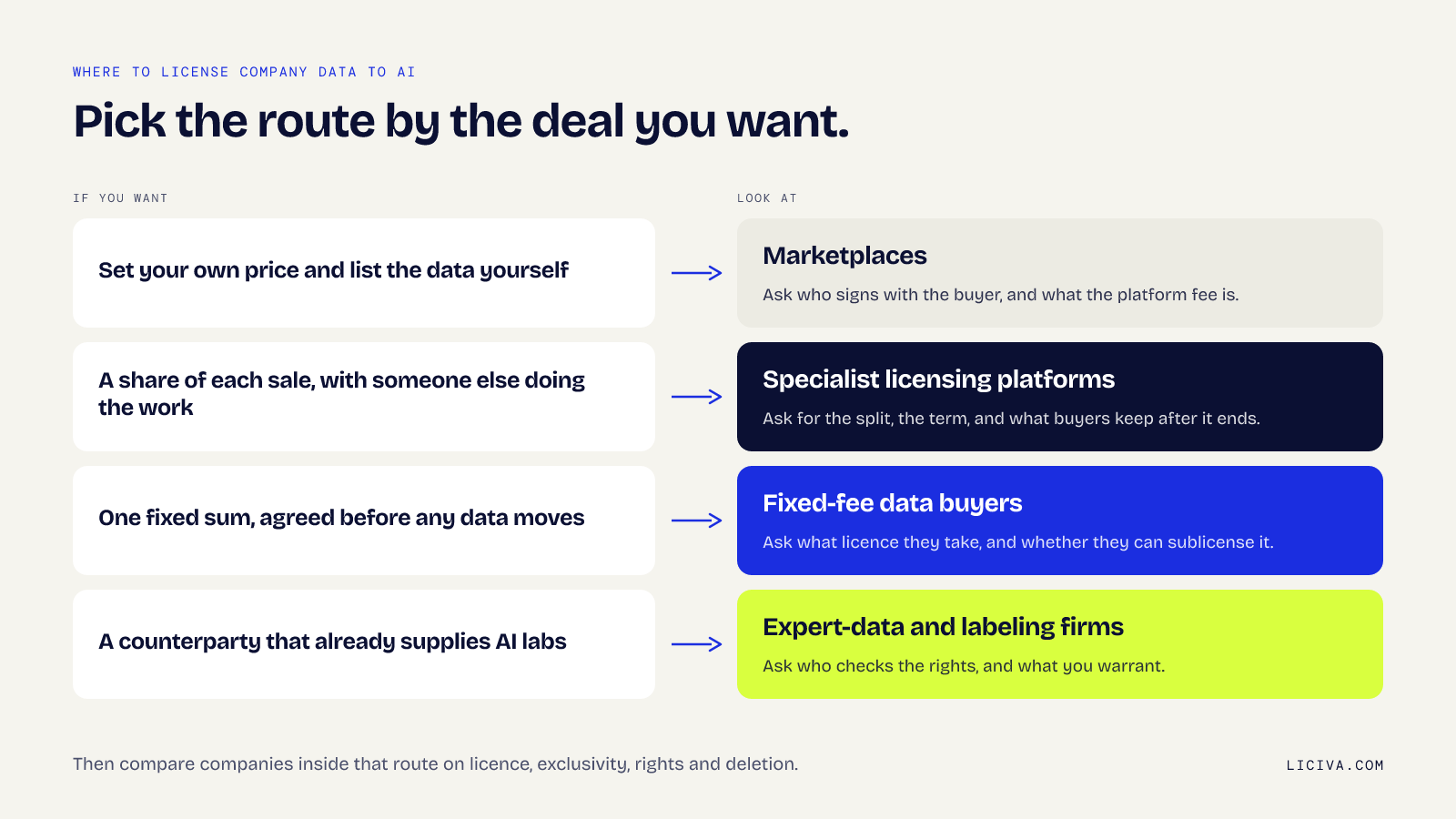
Every route ends with an AI lab training or evaluating on your records. What changes is who you sign with, who sets the price and what licence you grant on the way. These are the five groups, with what each company publishes about itself.
Marketplaces: you list, buyers browse
A marketplace suits an owner who wants to set a price and keep control of the listing. The trade-off is that you do more of the work, and in the published terms you carry the rights warranty.
- DataVendor, run by HUD, is a self-serve marketplace for codebases, tasksets and RL environments, with operational data listed as coming soon. Vendors set a price per unit. Its docs list a 20% platform fee, charged at withdrawal. Under its vendor data sharing agreement, the vendor licenses the data to HUD, which sublicenses it to buyers, and HUD deletes the data within 90 days of the end of the agreement, with stated exceptions such as continuing buyer agreements, and the deletion clause does not apply to derived data. DataVendor publishes all of its legal documents.
- Defined.ai sells datasets to AI teams through its marketplace and takes in data through a partner programme for audio, video, image, text and multimodal data. It says its vetting includes an “assessment of your licensing rights”, and its supplier programme terms include a mutual NDA from the moment you apply. Commercial terms are set per dataset and approved by the partner; the split is not published.
- Grepped values, prepares and lists company archives, such as Slack, Drive, email and code, and pays the owner when a lab buys. Its security page says it gets access only to sources you approve and only after the agreement is signed, and that it deletes original datasets once processing is done. Its terms say a licence can be exclusive or not, and that the owner is responsible for checking contracts, consents and laws.
Specialist licensing platforms: a revenue share on each sale
These platforms prepare your data and license it to model builders, and pay you a share when it sells. They suit owners who expect the data to sell more than once.
- Protege works across healthcare, video, audio and speech, and spatial data, and “formalize[s] licensing through a clear revenue share agreement”. Its provider terms give Protege a non-exclusive licence with the right to sublicense, put the ownership warranty and an indemnity on the provider, and let existing buyers keep access for twelve months after termination. The percentage is not published.
- SF Data turns production traces, starting with coding-agent sessions, into RL environments. Its essay on production traces says “the source company can share in the proceeds”. Process, terms and payment are not published.
Fixed-fee data buyers: a sum agreed up front
These companies pay you an agreed amount for a licence and then build datasets or environments for labs themselves. They suit owners who want one payment and little ongoing involvement. Read carefully what licence they take, because it decides what they can do with your data after you are paid.
- Polyshares calls itself a data lab and says “you are selling to us, not through us”. It publishes “$100K to $2M” per licence, paid net 30 to 60 once the data is approved and anonymised, with no fee or commission. Its data handling page says licences are exclusive by default and that a specialist partner anonymises the records. Polyshares asks the company to confirm it owns the records.
- Endless Data agrees a fixed sum with you before anything is shared, takes a non-exclusive licence (“You can license the same data to anyone else”) and then licenses the data on to labs. It publishes a list of what it never licenses, including customer, employee and client personal data and protected health information, and promises deletion at the end of the term.
- Nyne licenses de-identified operational data and delivers it to AI labs. It says partnerships are “commonly worth $100K or more” and paid once the dataset is delivered and accepted. Nyne gives the clearest warning in this set: “Your ability to export a record does not by itself establish permission to license it.” It says rights are reviewed as part of the partnership; the review is not described.
- Ooak Data anonymises company data into “digital twins” and builds RL environments from them. It says deals so far range from $20K to several hundred thousand dollars, that raw data is deleted within 30 days of delivery with written confirmation, and that “Counsel reviews everything before signature”. Its website terms say partnerships are governed by agreements that include a mutual NDA.
Expert and human-data firms with data programmes
These firms built their business supplying expert-made training data to AI labs and now also license company data. They suit owners who want a counterparty that already sells to labs. Several publish strong process detail; few publish licence terms.
- micro1 pays a fixed fee in published tiers (“$100K-500K”, “$500K-3M”, “$3M+”) within 30 days of acceptance, and de-identifies data in house. Its public data licence master terms grant micro1 a “nonexclusive, irrevocable, perpetual license, with the right to sublicense”, put the rights warranties and an indemnity on the owner, delete raw data 120 days after delivery and do not require models to be deleted or retrained.
- Mercor connects to your tools, such as Slack, Gmail, Salesforce and GitHub, extracts and de-identifies the data automatically, and pays by wire on delivery to the buyer, within 2 to 4 weeks of signing. It says “No AI lab buyer or third-party vendor ever sees your raw data.” Licence terms, exclusivity and deletion are not published.
- Handshake AI advertises “$100K to $4M+” for companies with at least 20 full-time employees and three years in operation, in a five-step guided process. Its privacy policy says it “acquires data from businesses and other organizations and makes data available to AI labs”. Licence terms are not published.
- AfterQuery runs a six-step process with a mutual NDA at step two, before any sample. It says identifiers are replaced with consistent pseudonyms, that payroll, privileged legal material and credentials are never used, and that every dataset gets a re-identification test. It proposes terms after reviewing a sample.
- Turing’s Project Lazarus prepares a company’s record at its own cost, recovered from sales, and pays a revenue share on each sale under one agreement. Its trust page puts the mutual NDA “before any data moves, sample included”. Licences are non-exclusive, and Turing is the only seller for the first 90 days. You keep ownership.
Labeling and data-services firms with data programmes
The best-known AI data firms also run data partnerships now. They suit owners who want a large counterparty, but published terms are thin.
- Scale AI wants companies with 40 or more employees and data from tools such as Slack, email, Jira and Salesforce. It says it “anonymizes everything inside your environment, before any data is extracted” and that you sign off every data package. It shows “$10K–$1M+” as an illustrative value, recurring with cadence. NDA, exclusivity, rights and deletion terms are not published.
- Labelbox’s Prism pays “an upfront licensing fee at signing plus a revenue share on downstream use”, with datasets “typically” starting around $50K. Partnerships are “exclusive by default”, and Prism publishes revocation and deletion clauses. Its how-it-works page describes a provenance step that hashes and watermarks every record, and its privacy page says buyer identities are disclosed to you before signing.
- Appen says “nothing is discussed further before a mutual NDA is in place”, that you set the scope and approve a sample, and that retention and deletion terms are agreed in writing before extraction. Each partnership is quoted individually and paid on acceptance. Appen also lists anonymised company archives in its data catalogue.
Who checks the rights, and what happens at the end?
This is the part of the deal that protects you, and the part least often published. The table below records what each company says on two questions: who confirms that the data is yours to license, and what happens to it when the deal ends.
| Company | Who checks the rights (as published) | Term and deletion (as published) |
|---|---|---|
| DataVendor | Vendor warranty and indemnity; automated secrets and personal-data scans | HUD deletes within 90 days of the end, with exceptions; derived data excluded |
| Defined.ai | Defined.ai assesses licensing rights; supplier is accountable | Not published for owner data |
| Grepped | Owner responsible; Grepped offers to go through it with you | Originals deleted after processing; retention set in the agreement |
| Protege | Provider warranty and indemnity | Existing buyers keep access 12 months after termination |
| SF Data | Not published | Not published |
| Polyshares | Owner confirms ownership | Defined term; deletion not published |
| Endless Data | Not published | Deletion at the end of the term; audit rights |
| Nyne | Reviewed as part of the partnership | Set per engagement, with deletion workflows |
| Ooak Data | Checked at scoping; counsel reviews before signature | Raw data deleted within 30 days of delivery |
| micro1 | Owner warranty and indemnity | Raw data deleted 120 days after delivery; perpetual licence |
| Mercor | Not published | Not published |
| Handshake AI | Due diligence mentioned; not described | Not published |
| AfterQuery | Not published | Not published |
| Turing (Project Lazarus) | Not published | 90-day sole-seller window; deletion not published |
| Scale AI | Not published | Not published |
| Labelbox (Prism) | Not published | Revocation and deletion clauses published |
| Appen | Not published | Agreed in writing before extraction |
Two patterns stand out. First, where terms are public, the rights warranty usually sits with the owner, often with an indemnity. That is normal in licensing, but it means a mistake about a customer contract or an employee notice is yours to carry, so you want the rights question answered before you sign, not after. Second, deleting the dataset does not unpick a trained model. micro1’s terms say so explicitly; Prism’s FAQ says models already trained on the data “cannot be unlearned”. Decide what you will accept on trained models before you negotiate price. The rights check post sets out the six questions to answer first.
Where does Liciva fit?
Liciva is one of the options, so it is described here separately rather than in the tables. Liciva arranges licences between data owners and AI teams, in any field. Its homepage describes a fixed order: a short call with no specifics, then a mutual NDA, then a small sample with personal data removed, then a written rights check, then a licence you approve line by line, and only then delivery and payment.
The rights check covers chain of title, third-party terms, personal data and consent, restrictions, use limits, and delivery and deletion, and is written up before any licence is drafted. Title stays with you, the licence names the permitted uses, you can exclude competitors or whole categories of use, and the licence ends with certified deletion. The call, the NDA, the sample review and the rights check cost nothing; Liciva earns only when a licence is signed and paid for, on terms agreed with you in advance. Liciva does not publish price ranges, because it gives a written view after the sample stage. It claims no clients or figures, and you should weigh it on its process like everyone else here.
How to choose where to sell your company’s data
Choose the route by the deal you want, then compare companies inside that route on the terms that protect you. These steps work for any of the 17.
- Decide what you will never allow. A competitor, a sector, a use such as pre-training. Write it down before anyone makes an offer.
- Pick the payment shape. One fixed sum, a revenue share on each sale, or a price you set on a marketplace. Each suits a different appetite for risk and involvement.
- Ask for a mutual NDA before any sample. Several companies above publish one. If a form asks for a file, schema or sample before an NDA exists, stop.
- Read the licence the company takes. Is it non-exclusive? Time-limited? Perpetual, irrevocable or sublicensable? Who can it sublicense to? This matters more than the headline figure.
- Ask who checks the rights, and what you warrant. If you carry the warranty and the indemnity, do your own rights check first.
- Agree deletion and trained models in writing. A deletion window, a certificate, and a clear answer on whether trained models stay in use.
- Compare offers on the same terms. A smaller non-exclusive, time-limited licence can be worth more than a larger perpetual one.
If your data includes internal email or chat, read the employee data post before you take any calls. For the deal itself, step by step, see how to license your company’s data to AI companies.
How we compared
We started from 19 companies that come up when data owners research licensing data to AI. We kept every company that publishes a programme for data owners and set aside the two that do not. Between 6 and 7 November 2026 we read each company’s homepage, its data-owner page, and its FAQ, terms and legal pages where these exist. On 7 November 2026 we fetched every page again and recorded only what was stated, with a link to the page.
We recorded six things for each: the kind of route, how the owner is paid, exclusivity, NDA, who checks the rights, and term and deletion. We did not use press coverage, reviews or our own opinion of quality, and we did not contact the companies. Where pages from the same company disagreed, we left the point out. Where a company makes claims about its own size, payouts or customers, we left them out, because we cannot check them. Figures in the tables are each company’s own headline numbers, quoted as published. Terms change often; check the linked page before you rely on anything here.
Where to start
Start with a page of notes on what you hold, whose information is in it and what you would never allow. Then talk to two or three companies from the route that fits, under NDA, and compare their licences side by side. If you want Liciva to be one of them, tell us what you hold. Nothing confidential changes hands until the NDA is signed.
Tags
Questions
Which companies buy company data for AI training?
In this comparison, 17 companies publish a programme for data owners: marketplaces (DataVendor, Defined.ai, Grepped), specialist licensing platforms (Protege, SF Data), fixed-fee data buyers (Polyshares, Endless Data, Nyne, Ooak Data), expert and human-data firms (micro1, Mercor, Handshake AI, AfterQuery, Turing) and labeling and data-services firms (Scale AI, Labelbox through Prism, Appen). Most then license the data on to AI labs.
Is selling company data to AI the same as licensing it?
Usually not. Most of these programmes take a licence, not ownership: you keep title and grant rights to use the data. What differs is the scope of that licence. Some published terms are non-exclusive and time-limited; others are perpetual, irrevocable or sublicensable. Read the licence the company takes, not the word on its landing page.
How much do AI companies pay for company data?
Only some companies publish figures, and they are headline ranges, not offers. As of 7 November 2026, Polyshares says $100K to $2M per licence, Handshake AI says $100K to $4M+, micro1 publishes tiers starting at $100K, Ooak Data says deals so far range from $20K to several hundred thousand dollars, and Scale AI shows $10K to $1M+ as an illustrative value. Your figure depends on the data, the rights and the terms.
Should we sign an NDA before sharing a sample?
Yes. Of the 17 programmes compared, Turing's Project Lazarus, AfterQuery, Appen, Defined.ai and DataVendor publish a mutual NDA before or at the start of the process. For the rest, an NDA is not mentioned on the pages we checked. Ask for one before any sample, file listing or schema leaves your company.
Who checks that we have the right to license the data?
In most published terms, you do. Protege, micro1 and DataVendor put the rights warranty and an indemnity on the owner; Polyshares asks the owner to confirm ownership; Grepped's terms make the owner responsible for checking contracts and consents. Defined.ai, Nyne and Ooak Data describe a review on their side. Many companies publish nothing on it.
Where does Liciva fit?
Liciva arranges licences between data owners and AI teams. It runs a mutual NDA before any sample and a written rights check before any licence, and the owner approves every permitted use. It is one of the options, which is why it is described separately and not ranked.
Related posts
Have data, or need it?
Both conversations start under NDA. Tell us what you hold, or what your model needs, and we come back with a clear next step.